
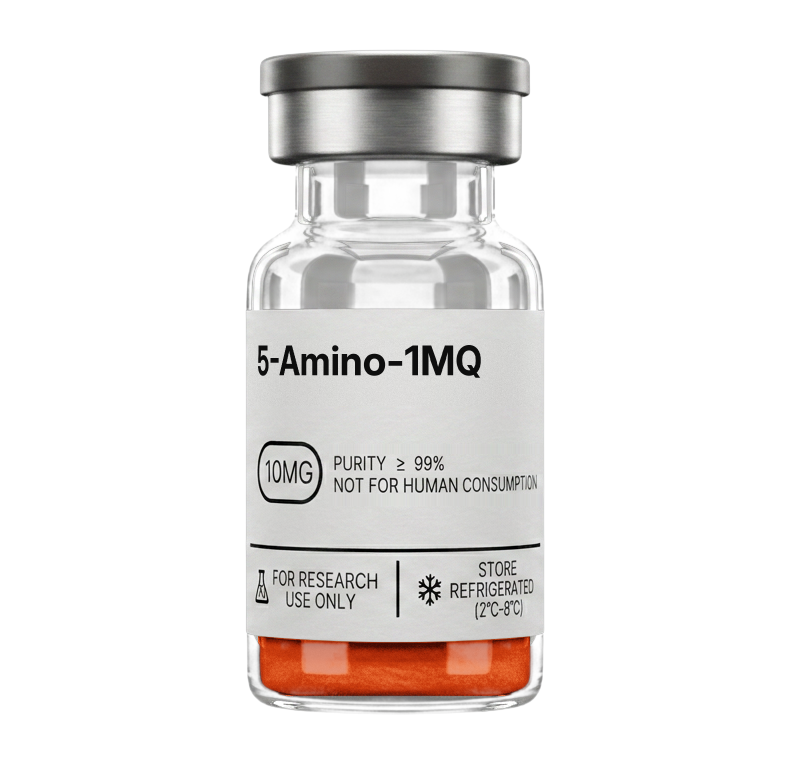



5-Amino-1MQ is often grouped with research peptides, but it is actually a small molecule. It was designed at the University of Texas Medical Branch to block NNMT, an enzyme linked to fat-tissue metabolism and cellular methylation. All published data so far come from cell and animal studies, so it helps to be clear about what the research shows and what it does not.
- 5-Amino-1MQ (5-amino-1-methylquinolinium) is a small-molecule NNMT inhibitor, not a peptide.
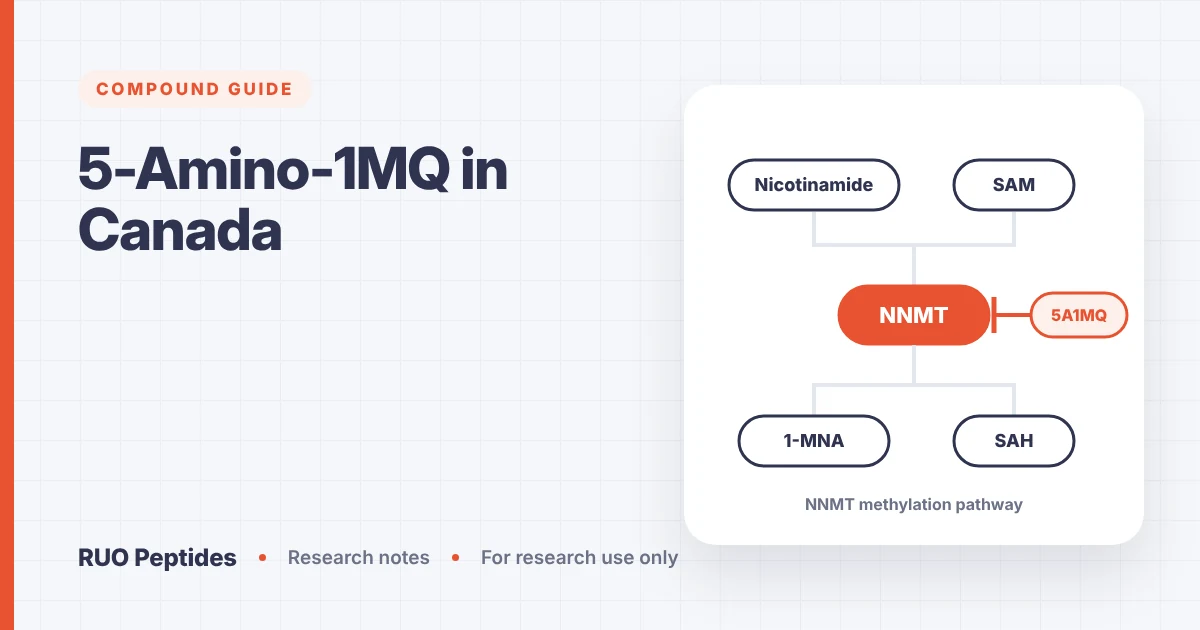
- NNMT methylates nicotinamide using SAM, linking it to NAD⁺ and methylation pathways.
- In diet-induced obese mice, it limited weight and fat-mass gain and improved glucose tolerance.
- It is not approved anywhere and has no published human trials. Check identity and salt form on the CoA.
5-Amino-1MQ at a glance
| Chemical name | 5-Amino-1-methylquinolinium (usually supplied as the iodide salt) |
| Other names | 5A1MQ, 5-Amino-1-MQ |
| Class | Small-molecule quinolinium compound (not a peptide) |
| Molecular formula | C10H11N2·I (iodide salt) |
| Molecular weight | 286.1 g/mol (iodide salt); cation 159.2 g/mol |
| CAS number | 42464-96-0 (iodide salt) |
| Target | Nicotinamide N-methyltransferase (NNMT); reported IC50 about 1.2 µM |
| Status | Preclinical research compound |
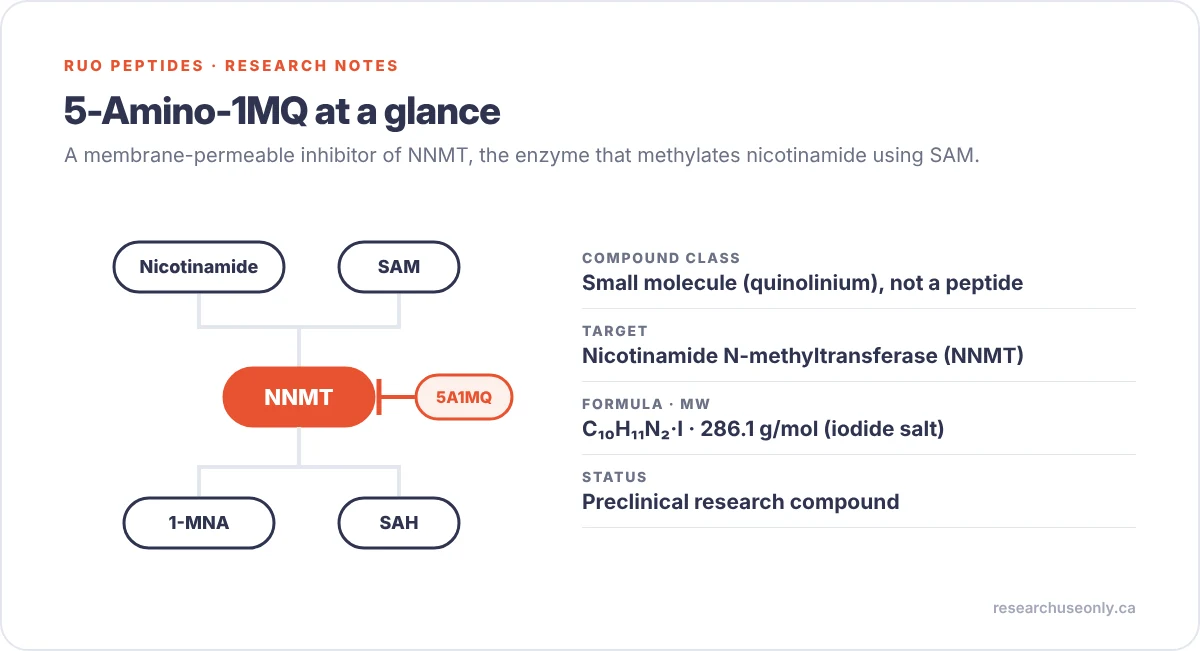
What NNMT does
Nicotinamide N-methyltransferase (NNMT) is an enzyme found mainly in the liver and in fat tissue. It takes a methyl group from S-adenosylmethionine (SAM) and attaches it to nicotinamide, a form of vitamin B3. The products are 1-methylnicotinamide (1-MNA) and S-adenosylhomocysteine (SAH).
This reaction matters for two reasons. Nicotinamide that is methylated can no longer be recycled into NAD⁺, a coenzyme central to energy metabolism. And each reaction uses up SAM, the cell’s main methyl donor. Higher NNMT levels have been reported in the fat tissue of obese mice and people, which is why researchers began looking for selective inhibitors.
What the research shows
5-Amino-1MQ came out of a structure-based screen of quinolinium compounds by Neelakantan, Watowich and colleagues. It binds the nicotinamide site of NNMT and is small enough to enter cells. Key published findings:
- Selectivity: it inhibits NNMT without measurably affecting related methyltransferases or enzymes in the NAD⁺ salvage pathway.
- Fat cells: in cultured 3T3-L1 adipocytes it lowered 1-MNA levels and reduced lipogenesis.
- Diet-induced obese mice: a 2024 study in Diabetes, Obesity and Metabolism reported that 28 days of treatment limited body-weight and fat-mass gain, improved glucose tolerance and insulin sensitivity, and reduced fatty liver in a dose-dependent way.
- Aged muscle: the same group reported that NNMT inhibition activated muscle stem cells and improved regeneration of injured muscle in aged mice.
What a CoA should confirm
Because 5-Amino-1MQ is a small salt rather than a peptide, a few checks differ from a typical peptide CoA. Look for:
- Mass spectrometry identity. The compound is a permanent cation, so expect a signal near m/z 159.1. The iodide counter-ion does not appear in positive-mode MS.
- HPLC purity with the chromatogram, not only a percentage.
- Salt form. The iodide salt weighs about 1.8 times as much as the active cation, so check whether the stated amount refers to the salt or to the free cation.
- Isomer identity. NMR or a reference standard can confirm the amino group is in the 5-position, separating it from other aminoquinolinium isomers with the same mass.
- A lot number that matches the vial.
For how these tests work together, see HPLC Purity vs. Mass Spec Identity and How to Read a Peptide Certificate of Analysis.

Canadian regulatory context
5-Amino-1MQ is not authorized as a drug or natural health product in Canada or any other country. Compounds sold with therapeutic claims are regulated as drugs. Health Canada’s April 2026 advisory on unauthorized injectable peptides states that labels such as “For Research Use Only – Not for Human Consumption” do not make a product legal for personal use or exempt it from drug regulations.
Frequently asked questions
Is 5-Amino-1MQ a peptide?
No. It is a small quinolinium molecule with a molecular weight under 300 g/mol. It is often sold alongside research peptides because it is studied in similar metabolic research.
Has 5-Amino-1MQ been tested in humans?
No controlled human trials have been published. The available data come from enzyme assays, cell culture and mouse studies.
How should 5-Amino-1MQ be stored?
Keep vials sealed, dry, refrigerated and protected from light. Chemical suppliers commonly recommend −20 °C for long-term storage of the solid. See Lyophilized Peptide Storage and Handling for general guidance.
Sources
- Babula JAJ, Bui D, Stevenson HL, Watowich SJ, Neelakantan H. Nicotinamide N-methyltransferase inhibition mitigates obesity-related metabolic dysfunction. Diabetes, Obesity and Metabolism (2024)
- NNMT inhibition and aged muscle stem cells, Neelakantan et al.
- 5-Amino-1-methylquinolinium iodide compound data, Sigma-Aldrich
- Health Canada, advisory on unauthorized injectable peptides (April 2026)