


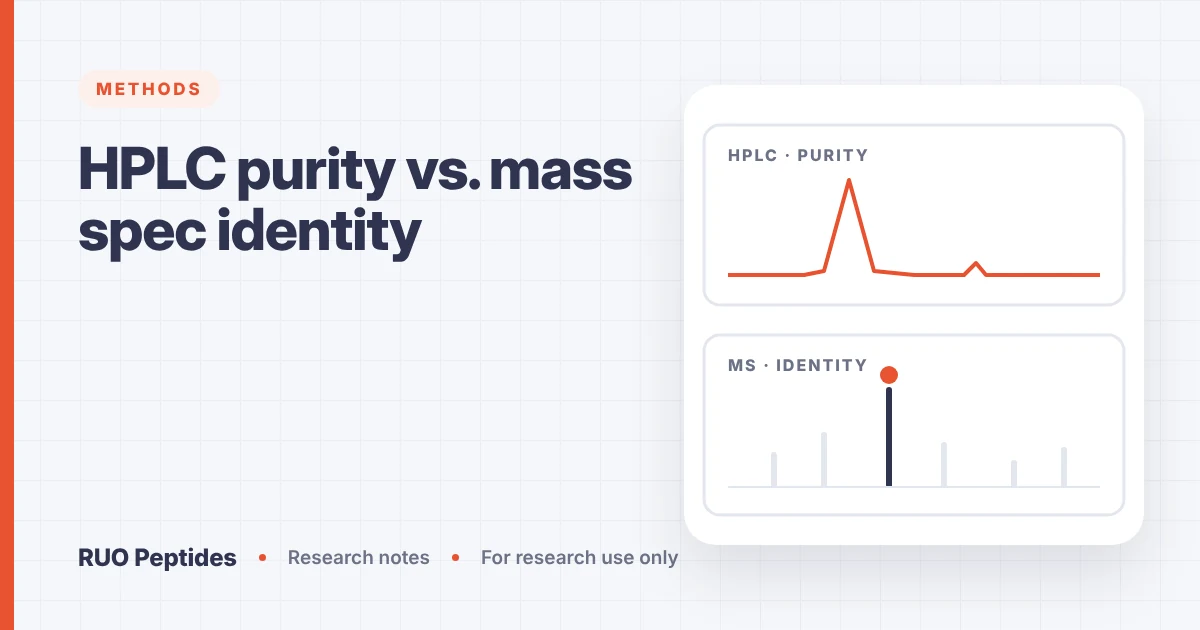
Two tests appear on almost every research peptide certificate: high-performance liquid chromatography (HPLC) and mass spectrometry (MS). They are often read together as a single “quality” result, but they answer different questions. Knowing the difference helps you read a Certificate of Analysis more critically.
- HPLC answers “how clean is the sample?” It reports the share of signal in the main peak.
- Mass spectrometry answers “is it the right molecule?” It compares observed and expected mass.
- Either test on its own leaves a gap. A complete CoA reports both.
- Blends need identity and purity data for each component.
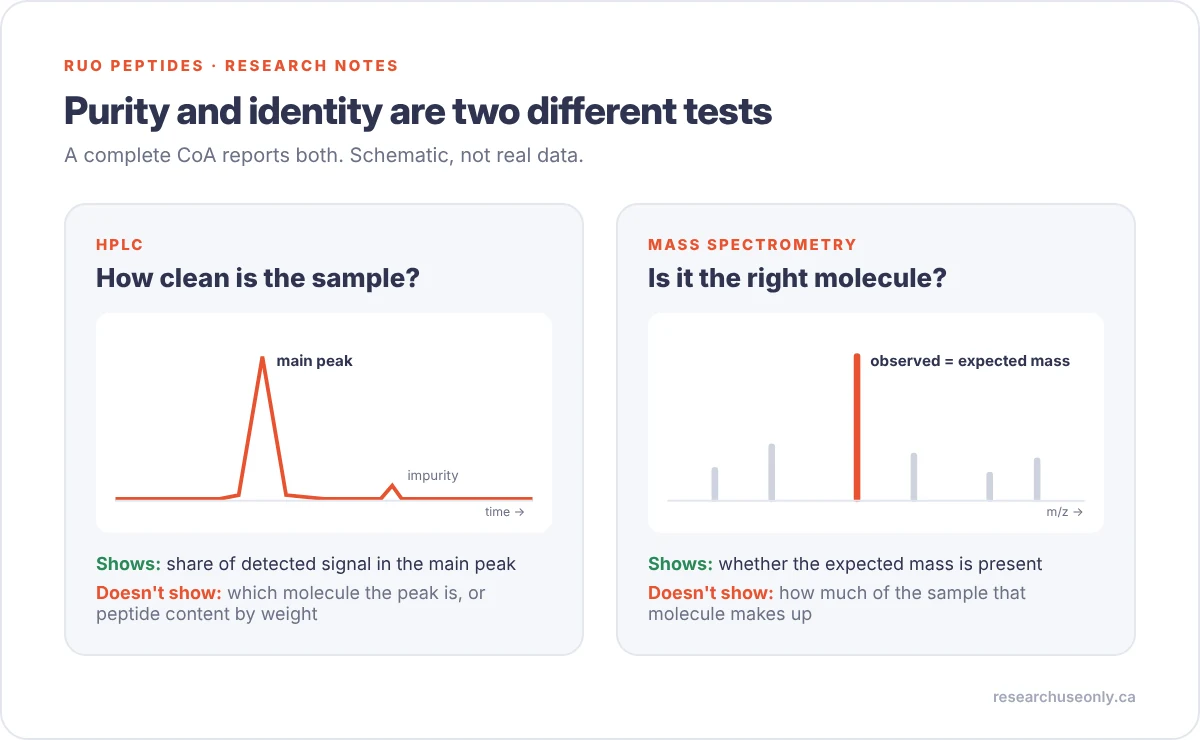
HPLC answers: how clean is the sample?
HPLC separates the components of a sample as they pass through a column. A detector, usually UV absorbance near 214–220 nm, records each component as a peak on a chromatogram. Purity is calculated as the area of the main peak divided by the total area of all peaks.
What this tells you:
- How much of the detected material elutes as one main component
- Whether there are visible related impurities, such as truncated or modified sequences
What it does not tell you:
- Which molecule the main peak is. A wrong peptide can still produce one clean peak.
- How much peptide is in the vial by weight. Water, salts and counter-ions are not part of the calculation.
- Impurities the detector cannot see at the chosen wavelength.
Mass spectrometry answers: is it the right molecule?
MS measures the mass-to-charge ratio of ionized molecules. For a peptide, the observed mass is compared with the theoretical mass calculated from its amino acid sequence. A close match is strong evidence that the expected sequence is present.
What MS does not tell you on its own is how much of the sample that molecule makes up. A spectrum can confirm the right peptide is there while other material is present alongside it.
Why you want both
| Test | Question it answers | Gap if used alone |
| HPLC | How clean is the sample? | Could be a clean sample of the wrong compound |
| Mass spectrometry | Is it the right molecule? | Could be the right compound with significant impurities |
Together, each test covers the other’s blind spot: HPLC shows the sample is mostly one component, and MS shows that component has the expected mass.
Blends need extra care
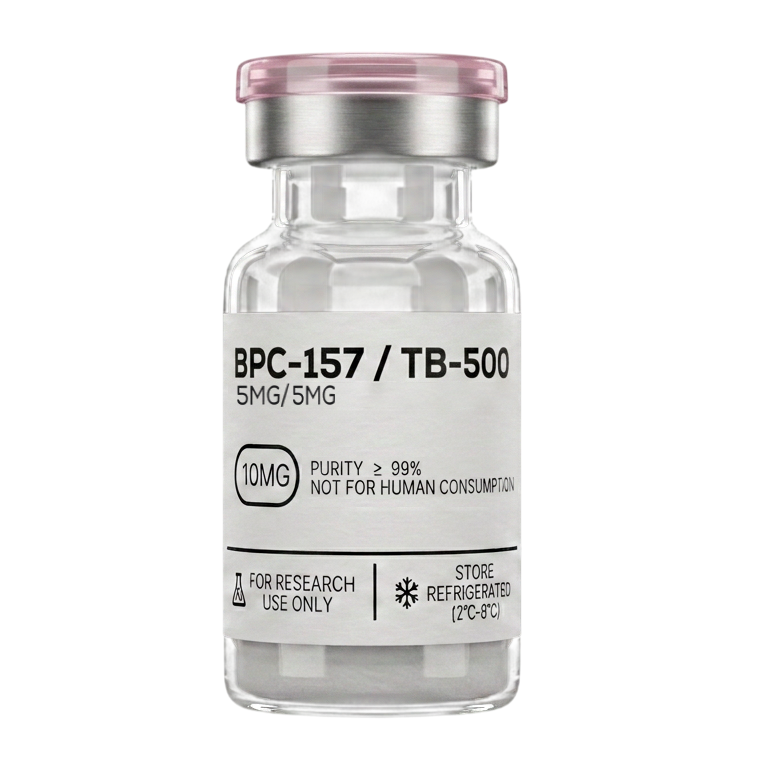
For a multi-component product such as a two-peptide blend, a single purity figure is harder to interpret. Ideally the documentation shows separate peaks and separate mass confirmations for each component, so you can see that both are present. Our BPC-157 and TB-500 guide covers this in more detail.
Reading the raw data
When a supplier can share the chromatogram and mass spectrum, not just a summary table, you can check for yourself:
- One dominant peak, with a baseline free of large unexplained peaks
- An observed mass that matches the theoretical value
- Sample and lot details that match the vial
For a walkthrough of the whole certificate, see How to Read a Peptide Certificate of Analysis.
Frequently asked questions
What does HPLC stand for?
High-performance liquid chromatography. It separates the components of a sample so each can be detected and measured.
Can a peptide be 99% pure and still be the wrong compound?
Yes. HPLC purity only shows that one component dominates. Mass spectrometry is needed to confirm that component is the intended peptide.
What does a mass about 16 Da higher than expected mean?
It can indicate an oxidized form, often at a methionine residue. It is worth asking the supplier about if it appears as a significant peak.
Related reading
Browse the catalogue: see the current research peptides available in Canada, each listed with amount, purity and storage details. For research use only.