


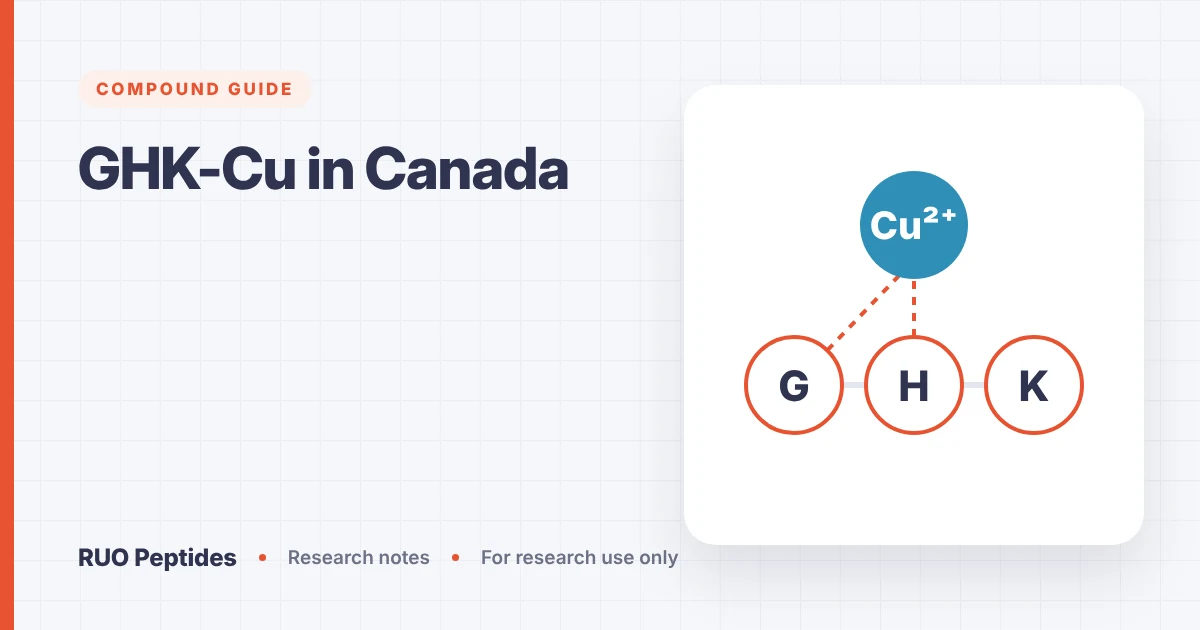
GHK-Cu is one of the smallest and longest-studied peptides in the research catalogue. It also has a life outside the laboratory as a cosmetic ingredient, which makes it important to be clear about which kind of product you are dealing with.
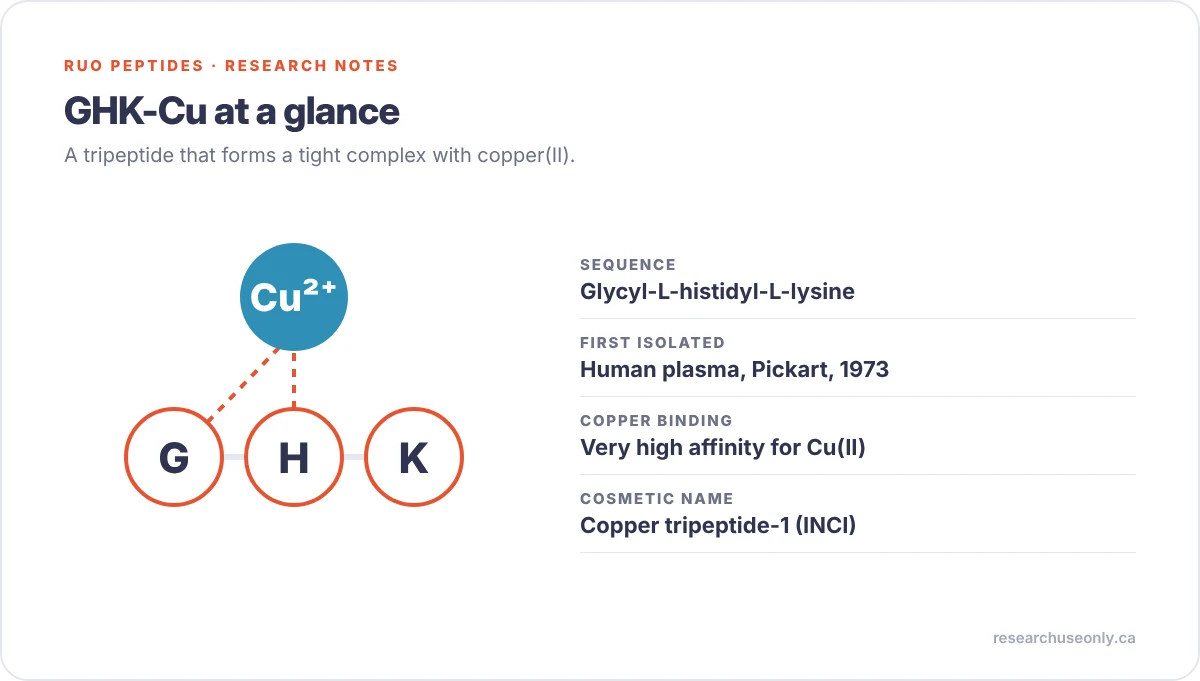
- GHK is the tripeptide glycyl-L-histidyl-L-lysine. GHK-Cu is its copper(II) complex.
- It was first isolated from human plasma by Loren Pickart in 1973.
- Cosmetic “copper tripeptide-1” and research-use GHK-Cu vials are different products.
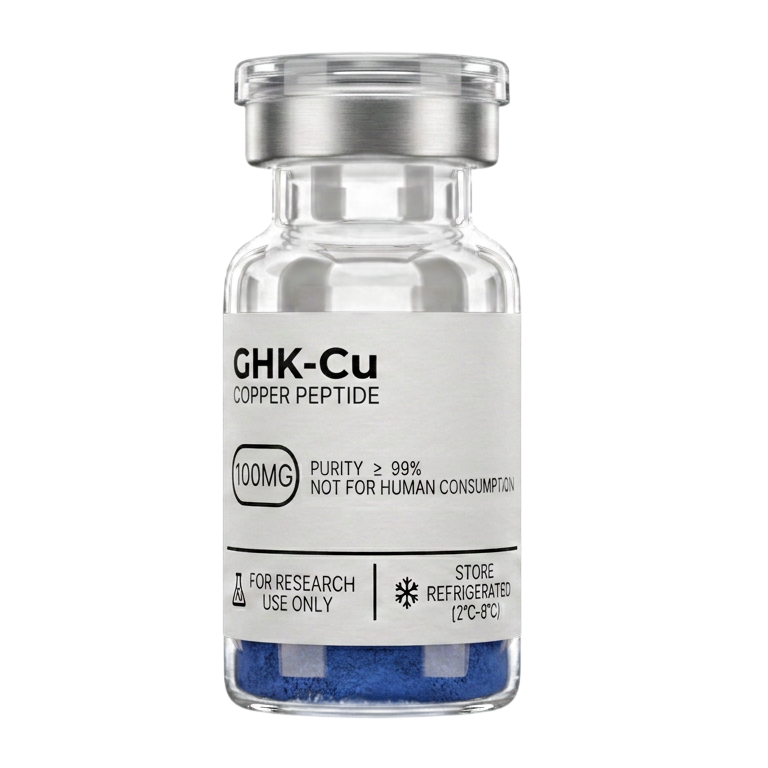
- GHK-Cu is normally blue. Named in Health Canada’s April 2026 advisory.
GHK-Cu at a glance
| Sequence | Glycyl-L-histidyl-L-lysine (Gly-His-Lys) |
| Form | Copper(II) complex |
| First isolated | Human plasma, Loren Pickart, 1973 (structure confirmed 1977) |
| Occurs naturally in | Plasma, saliva and urine. Plasma levels decline with age |
| Cosmetic name | Copper tripeptide-1 (INCI) |
| Approval status | Not an approved drug in Canada |
Research focus
Decades of preclinical work have looked at GHK-Cu in wound-healing models, collagen and extracellular matrix production in fibroblasts, and anti-inflammatory and antioxidant activity. It has also been studied for its effects on gene expression. Human studies have mostly involved topical cosmetic use and have generally been small and short.
Cosmetic ingredient vs. research material
Synthetic GHK-Cu appears in skin and hair products under the ingredient name “copper tripeptide-1.” That cosmetic use is separate from research-use GHK-Cu sold in vials. A research-use vial is not a cosmetic, is not formulated for skin, and is intended only for laboratory work.
What a CoA should confirm
Because GHK-Cu is a metal complex, documentation should make clear what was measured:
- Identity of the GHK peptide by mass spectrometry, and ideally confirmation of the copper complex
- Purity by HPLC
- The stated amount, and whether it refers to the complex or the peptide alone
- A lot number that matches the vial
Canadian regulatory context
On April 9, 2026, Health Canada issued a public advisory about unauthorized injectable peptides sold online. GHK-Cu was among the compounds it named. The advisory states that labels such as “For Research Use Only – Not for Human Consumption” do not make a product legal for personal use or exempt it from drug regulations. Health Canada also reported seizures of unauthorized peptide products and said it is working with the Canada Border Services Agency on imports.
Frequently asked questions
What does GHK stand for?
The single-letter codes for its three amino acids: glycine (G), histidine (H) and lysine (K).
Why is GHK-Cu blue?
The colour comes from the bound copper(II) ion.
Is research-use GHK-Cu the same as the cosmetic ingredient?
No. The cosmetic ingredient is formulated for skin products. A research-use vial is intended only for laboratory work.