
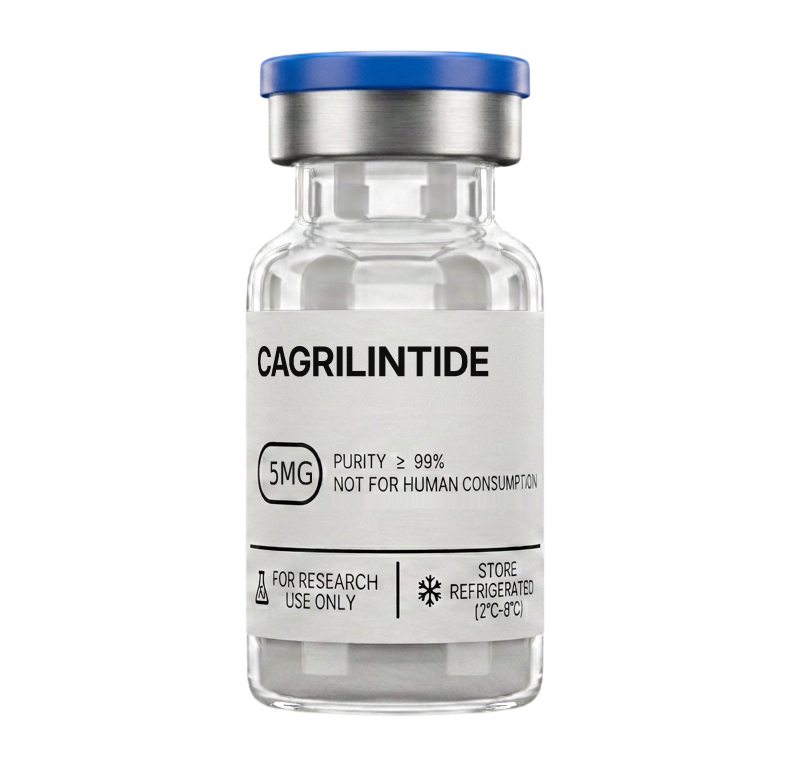


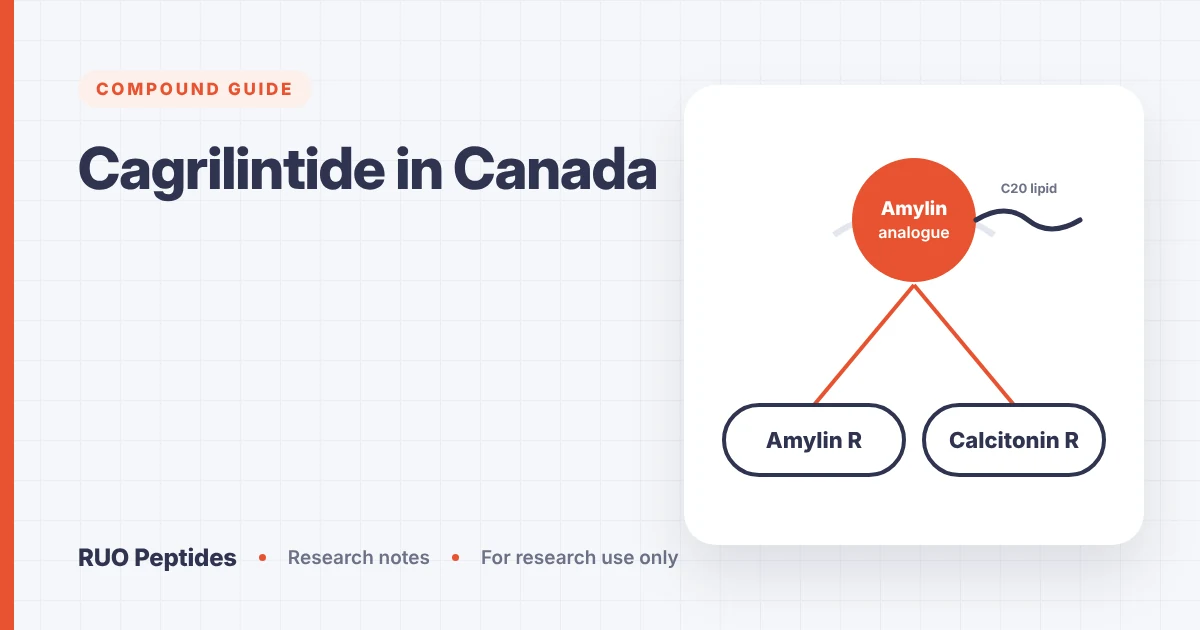
Cagrilintide is one of the most closely watched investigational peptides of the past few years, mainly because of its role in Novo Nordisk’s CagriSema program. That attention makes it important to separate the drug candidate being studied in clinical trials from material sold for laboratory research.
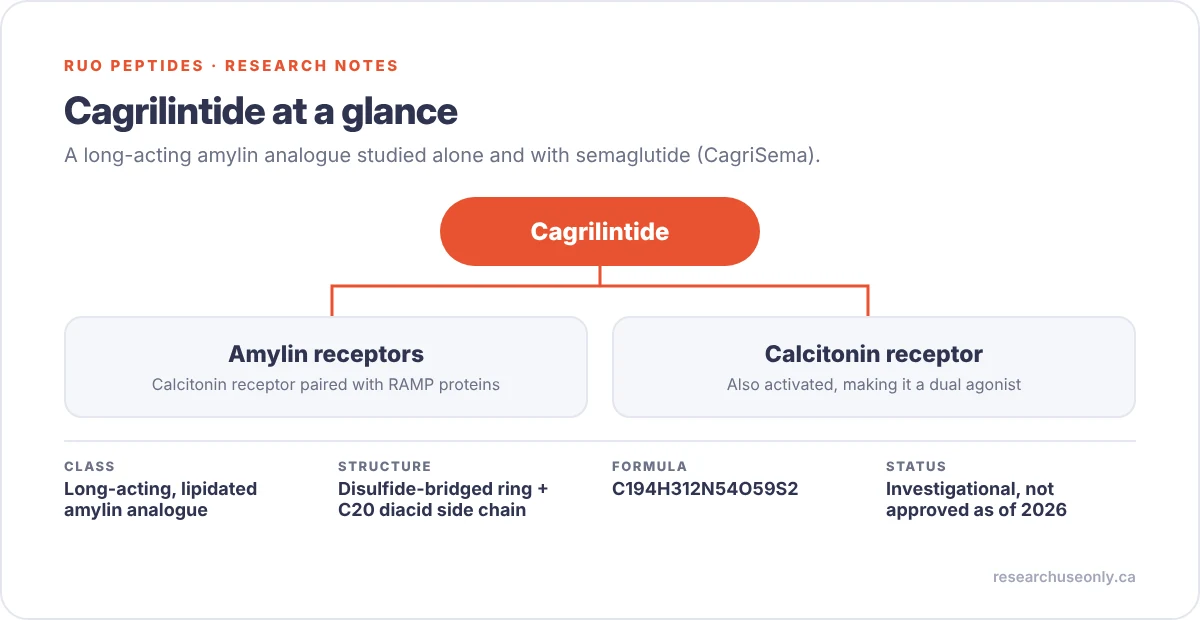
- Cagrilintide is a long-acting, lipidated amylin analogue that acts on amylin and calcitonin receptors.
- It is being studied alone and combined with semaglutide as CagriSema.
- Novo Nordisk filed for US FDA approval of CagriSema in December 2025. It is not approved anywhere as of October 2026.
- Research-use cagrilintide is not the clinical product. Check identity carefully on the CoA.
Cagrilintide at a glance
| Class | Long-acting amylin analogue |
| Receptor targets | Amylin receptors and the calcitonin receptor |
| Structure | Peptide with a disulfide-bridged ring and a C20 diacid side chain attached through a gamma-glutamic acid linker |
| Molecular formula | C194H312N54O59S2 |
| Developer | Novo Nordisk |
| Approval status | Investigational. Not approved anywhere as of October 2026 |
What is amylin, and how is cagrilintide different?
Amylin is a natural peptide hormone released from the pancreas alongside insulin. It acts on amylin receptors, which are formed when the calcitonin receptor pairs with accessory proteins called RAMPs. Native amylin is short-lived in the body, which limits its use as a research tool.
Cagrilintide was designed as a long-acting analogue. Its lipid side chain, a 20-carbon diacid, lets it bind to albumin in the blood, which slows its clearance. It also activates the calcitonin receptor directly, which is why it is often described as a dual amylin and calcitonin receptor agonist.
Clinical trial status
Novo Nordisk has studied cagrilintide both alone and in combination with semaglutide (CagriSema) in its Phase 3 REDEFINE program:
- REDEFINE 1 studied 3,417 adults with obesity or overweight without diabetes over 68 weeks. CagriSema produced an average weight reduction of 20.4%, compared with 3.0% for placebo. Cagrilintide alone produced 11.8%, compared with 2.3% for placebo.
- REDEFINE 2 studied 1,206 adults with type 2 diabetes and obesity or overweight over 68 weeks.
- REDEFINE 4 compared CagriSema with tirzepatide over 84 weeks. Novo Nordisk reported in February 2026 that it did not meet its primary endpoint of non-inferiority to tirzepatide.
Novo Nordisk submitted a New Drug Application for CagriSema to the US FDA in December 2025, with a decision expected in late 2026. As of October 2026, neither cagrilintide nor CagriSema is approved by any regulator.
What a CoA should confirm
Cagrilintide is a large, modified peptide with a disulfide bridge and a lipid side chain, which makes both synthesis and analysis more demanding. Look for:
- Mass spectrometry identity matching cagrilintide’s expected mass, which distinguishes it from unmodified amylin analogues such as pramlintide
- HPLC purity with a well-resolved main peak
- A lot number matching the vial, and a stated amount consistent with the label (for example 5 mg)
For how these tests work together, see HPLC Purity vs. Mass Spec Identity.

Canadian regulatory context
In Canada, peptides with therapeutic use are generally regulated as prescription drugs. Health Canada’s April 2026 advisory on unauthorized injectable peptides states that labels such as “For Research Use Only – Not for Human Consumption” do not make a product legal for personal use or exempt it from drug regulations.
Frequently asked questions
Is cagrilintide approved in Canada?
No. Cagrilintide is investigational and is not approved in any country, either alone or as part of CagriSema.
What is CagriSema?
CagriSema is Novo Nordisk’s investigational once-weekly combination of cagrilintide and semaglutide. An application for US approval was filed in December 2025.
How is cagrilintide different from semaglutide?
Semaglutide acts on the GLP-1 receptor. Cagrilintide is an amylin analogue that acts on amylin and calcitonin receptors, a different hormone system.
Sources
- Novo Nordisk CagriSema NDA submission, reported by Patient Care Online, December 2025
- REDEFINE 4 results, reported by HCPLive, February 2026