




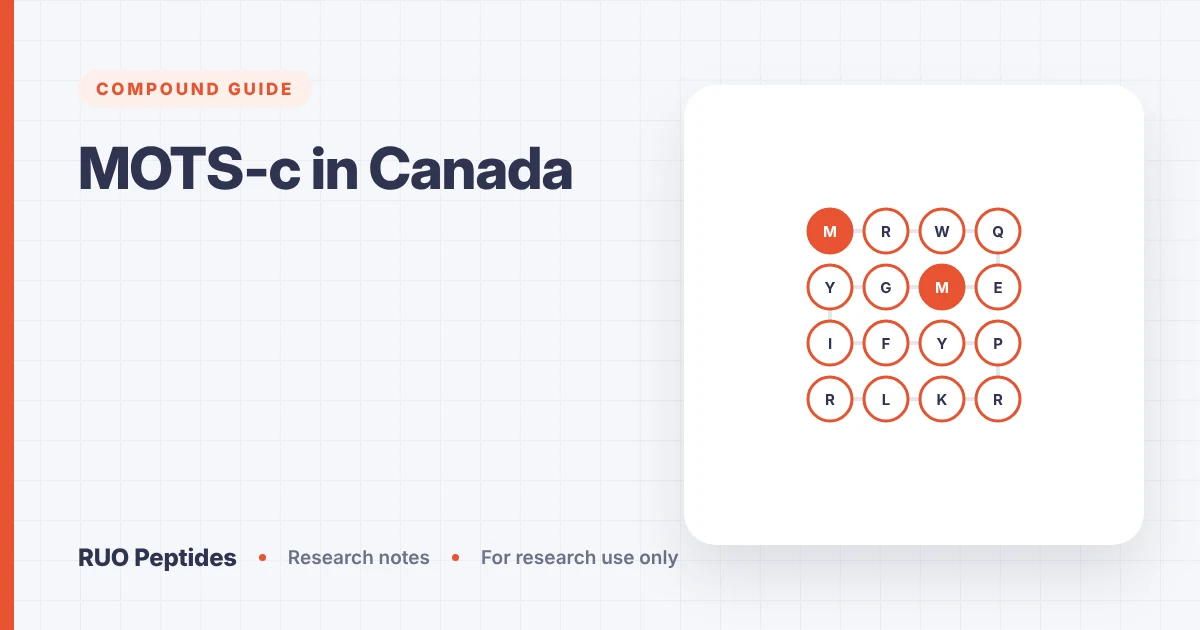
MOTS-c belongs to a small group of peptides encoded in mitochondrial DNA rather than in the cell nucleus. That origin is what made it notable when it was first described, and it remains a subject of active preclinical research.
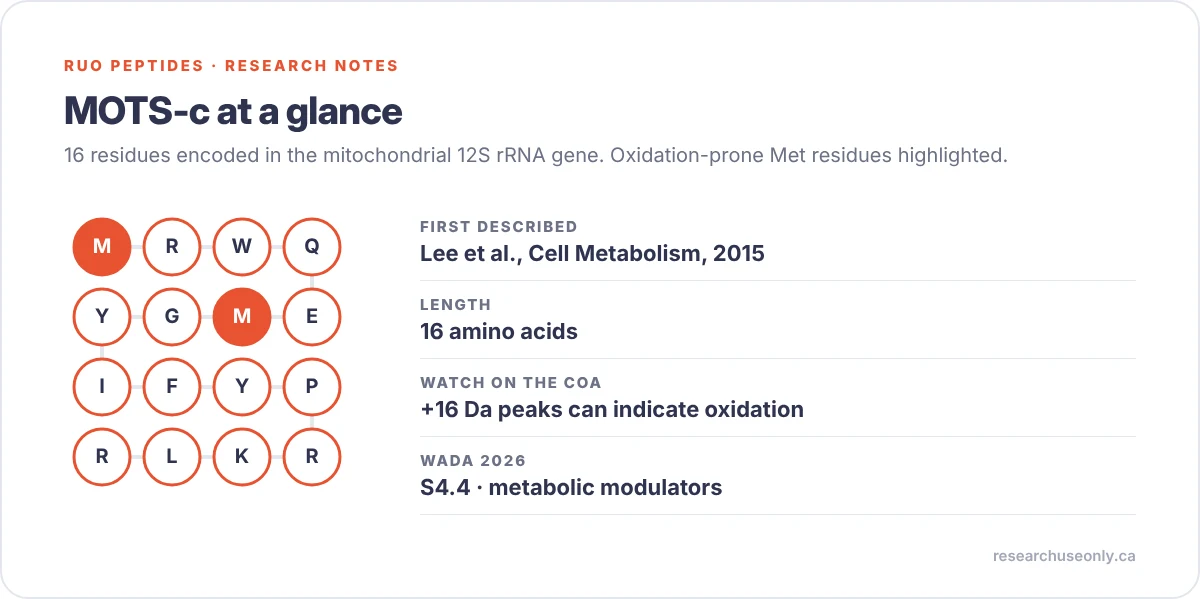
- MOTS-c is a 16-amino-acid peptide encoded in the mitochondrial 12S rRNA gene.
- It was first described by Lee and colleagues in Cell Metabolism (2015).
- Two methionines and a tryptophan make it oxidation-prone. Watch for +16 Da peaks.
- Named in Health Canada’s April 2026 advisory and listed by WADA under S4.4.
MOTS-c at a glance
| Full name | Mitochondrial open reading frame of the 12S rRNA type-c |
| Sequence | Met-Arg-Trp-Gln-Glu-Met-Gly-Tyr-Ile-Phe-Tyr-Pro-Arg-Lys-Leu-Arg |
| Length | 16 amino acids |
| First described | Lee et al., Cell Metabolism, 2015 |
| Approval status | Not approved as a drug in Canada or elsewhere |
| WADA 2026 | S4.4, metabolic modulators |
Research focus
Published work on MOTS-c has mainly looked at cellular metabolism, including its relationship to the AMPK signalling pathway and glucose handling, in cell and animal models. As with many research peptides, findings in mice do not establish effects in people.
What a CoA should confirm
MOTS-c contains two methionine residues and a tryptophan, which makes it more prone to oxidation than many short peptides. When reviewing documentation, look for:
- Mass spectrometry identity matching the theoretical mass of the 16-residue sequence. A mass about 16 Da higher can indicate an oxidized form.
- HPLC purity with a clearly dominant main peak
- A lot number that matches the vial
Anti-doping status
The WADA 2026 Prohibited List names MOTS-c under S4.4 (metabolic modulators), as prohibited at all times.
Canadian regulatory context
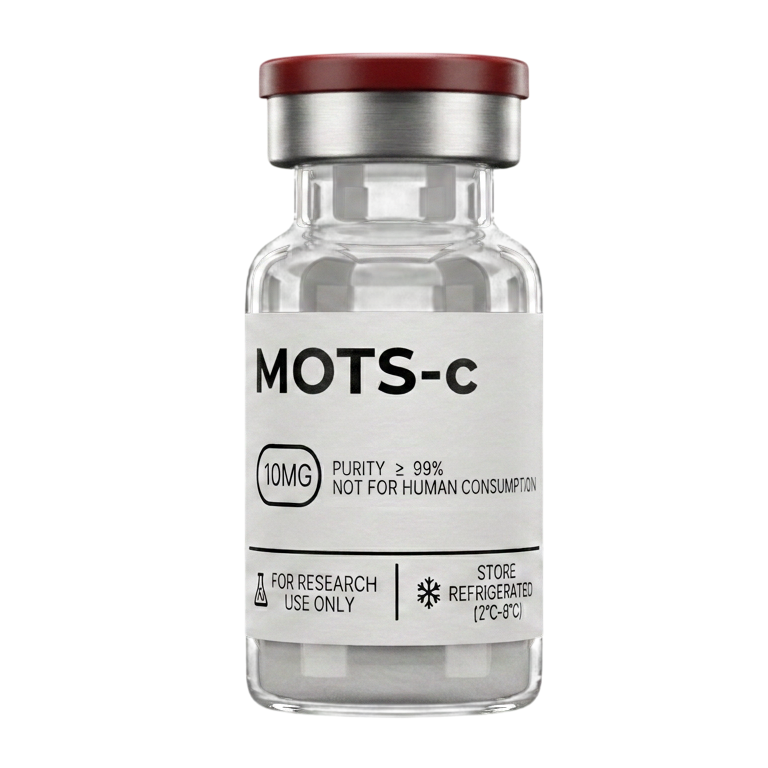
On April 9, 2026, Health Canada issued a public advisory about unauthorized injectable peptides sold online. MOTS-c was among the compounds it named. The advisory states that labels such as “For Research Use Only – Not for Human Consumption” do not make a product legal for personal use or exempt it from drug regulations. Health Canada also reported seizures of unauthorized peptide products and said it is working with the Canada Border Services Agency on imports.
Frequently asked questions
What does MOTS-c stand for?
Mitochondrial open reading frame of the 12S rRNA type-c. The name describes where in the mitochondrial genome the peptide is encoded.
How long is MOTS-c?
16 amino acids.
Is MOTS-c approved in Canada?
No. It is not an approved drug, and it was named in Health Canada’s April 2026 advisory on unauthorized peptides.