
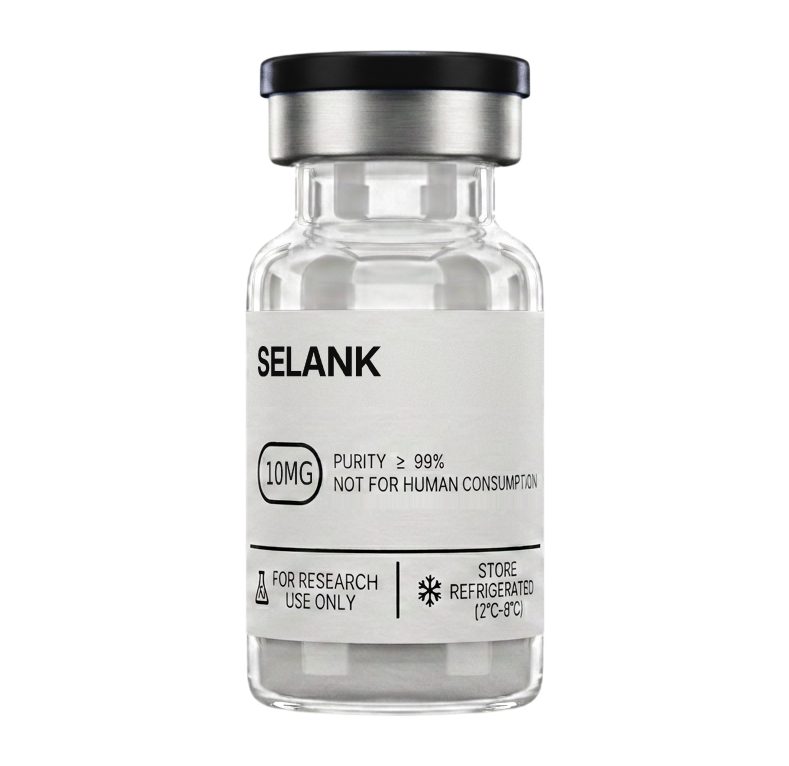

Selank is a short synthetic peptide developed in Russia and studied mainly for its effects on anxiety-related behaviour and the immune system. It is a registered medicine in Russia but is not approved in Canada, the US or the EU, so most of what is known comes from Russian laboratory and clinical research.
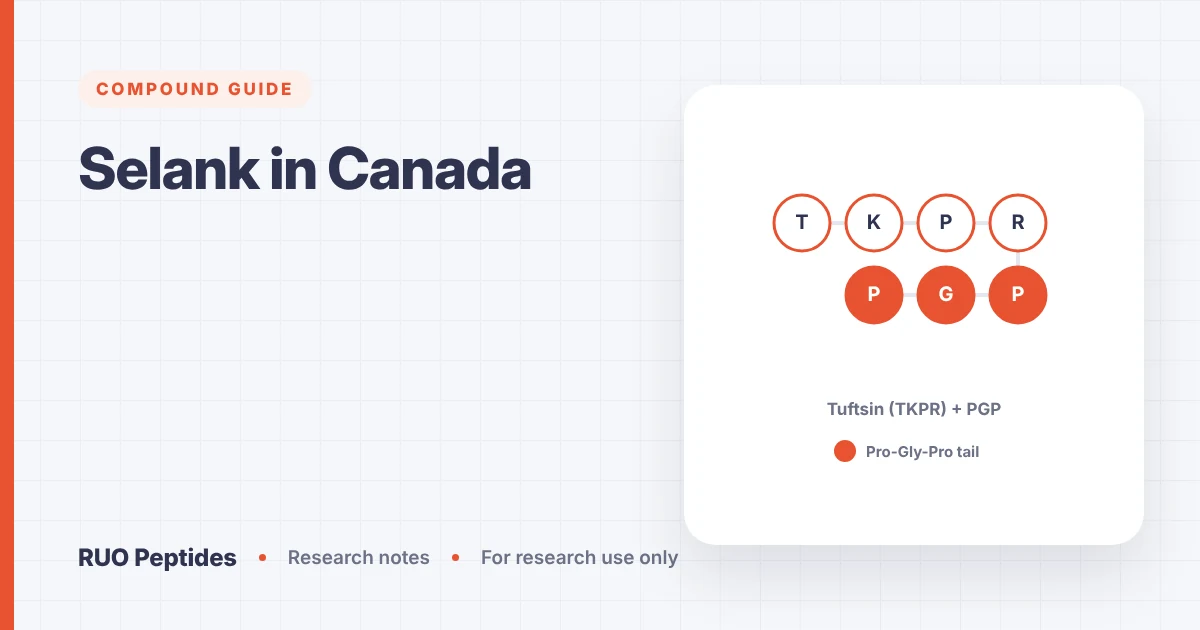
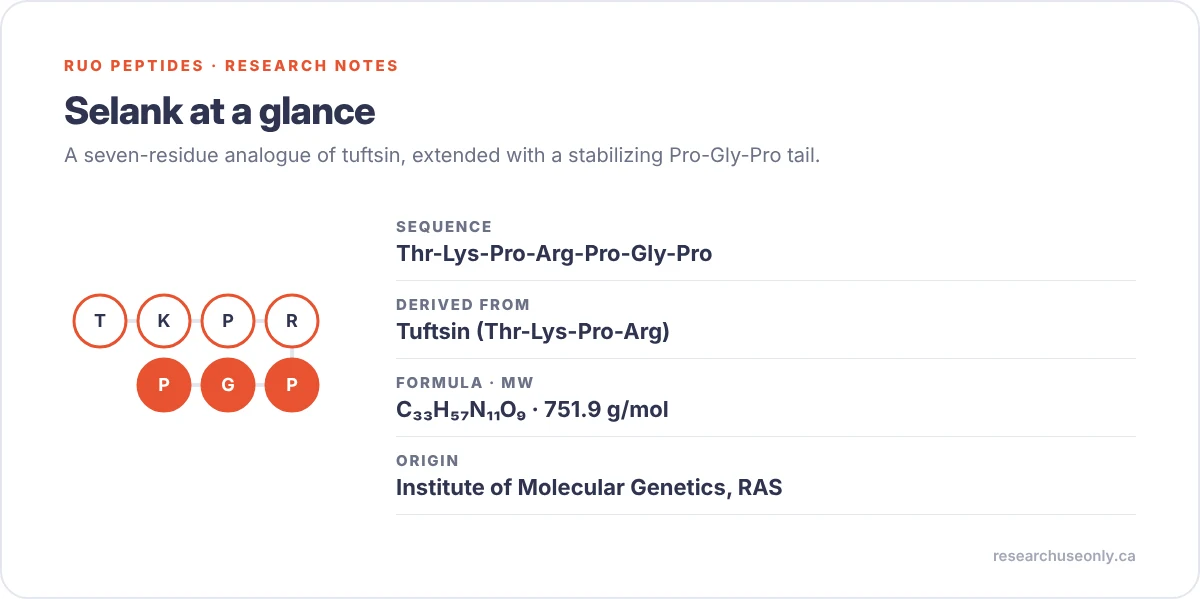
- Selank is a seven-residue peptide (Thr-Lys-Pro-Arg-Pro-Gly-Pro) based on the natural peptide tuftsin.
- The added Pro-Gly-Pro tail makes it more resistant to breakdown than tuftsin.
- Studies describe effects on GABA signalling, enkephalin breakdown, BDNF and immune-related genes, mostly in rodents.
- It is not approved in Canada. Research-use Selank is not the Russian medicine. Check identity on the CoA.
Selank at a glance
| Class | Synthetic heptapeptide, tuftsin analogue |
| Sequence | Thr-Lys-Pro-Arg-Pro-Gly-Pro (TKPRPGP) |
| Molecular formula | C33H57N11O9 |
| Molecular weight | 751.9 g/mol (free base) |
| CAS number | 129954-34-3 (free base) |
| Developer | Institute of Molecular Genetics, Russian Academy of Sciences |
| Status | Registered in Russia; not approved in Canada, the US or the EU |
Where Selank comes from
Tuftsin is a natural four-residue peptide (Thr-Lys-Pro-Arg) released from immunoglobulin G, known for stimulating immune cells. On its own it is broken down within minutes. Researchers at the Institute of Molecular Genetics in Moscow extended it with a Pro-Gly-Pro sequence, a motif that resists peptidases, to make a longer-lasting analogue. The result was Selank.
Selank was developed in Russia as a nasal formulation for anxiety-related conditions. Almost all clinical work on it has been carried out and published in Russia.
What the research describes
Published work on Selank covers several systems. The main reported findings are:
- GABA signalling: in rat hippocampal slices, Selank increased inhibitory synaptic currents, which is consistent with a modulating effect on GABA-A receptors (Povarov et al., 2017).
- Enkephalin breakdown: it inhibited enzymes in human serum that degrade enkephalins (Kost et al., 2001).
- BDNF: intranasal Selank rapidly increased BDNF expression in the rat hippocampus (Inozemtseva et al., 2008).
- Monoamines: it altered serotonin and dopamine metabolism in mouse and rat brain studies.
- Immune genes: consistent with its tuftsin origin, studies report changes in IL-6 and other immune-related gene expression.
What a CoA should confirm
Selank contains three prolines and a run of basic residues, so related synthesis by-products can be close in mass and retention time. Look for:
- Mass spectrometry identity close to the expected monoisotopic mass of about 751.4 Da, usually seen as [M+H]⁺ near 752.4 or [M+2H]²⁺ near 376.7.
- HPLC purity with the chromatogram, not only a percentage.
- Salt form. Selank is often supplied as an acetate salt, which weighs more than the free peptide.
- A lot number that matches the vial.
For how these tests work together, see HPLC Purity vs. Mass Spec Identity and How to Read a Peptide Certificate of Analysis.

Canadian regulatory context
Selank is not authorized as a drug by Health Canada, and its registration in Russia does not carry over to Canada. In Canada, peptides with therapeutic use are generally regulated as prescription drugs. Health Canada’s April 2026 advisory on unauthorized injectable peptides states that labels such as “For Research Use Only – Not for Human Consumption” do not make a product legal for personal use or exempt it from drug regulations.
Frequently asked questions
Is Selank approved in Canada?
No. Selank is registered in Russia but has not been authorized by Health Canada, the US FDA or the European Medicines Agency.
How is Selank related to Semax?
Both were developed at the Institute of Molecular Genetics in Moscow and both end in the same Pro-Gly-Pro tail. Selank is based on tuftsin, while Semax is based on a fragment of ACTH. See Semax in Canada.
How should lyophilized Selank be stored?
Keep vials sealed, dry and refrigerated at 2–8 °C, protected from light. See Lyophilized Peptide Storage and Handling for details.
Sources
- Selank compound data and cited studies, Cayman Chemical
- Selank overview and research history, Wikipedia
- Health Canada, advisory on unauthorized injectable peptides