
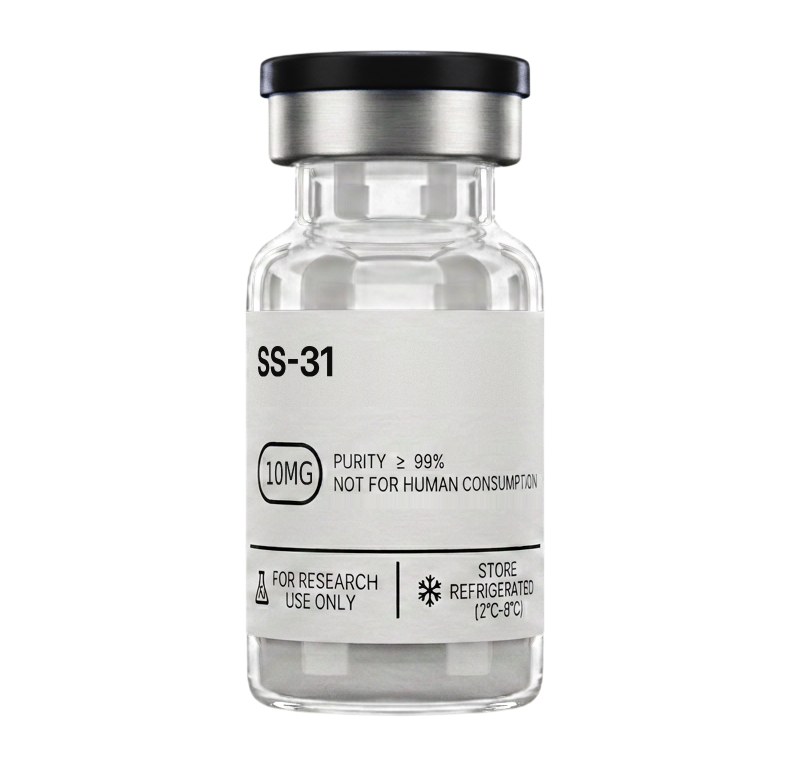



SS-31 is a small synthetic peptide that has been studied for more than two decades because of one unusual property: it passes into cells and concentrates on the inner membrane of mitochondria. Under the name elamipretide it became, in 2025, the first mitochondria-targeted drug approved by the US FDA. That makes it important to separate the approved drug from material sold for laboratory research.
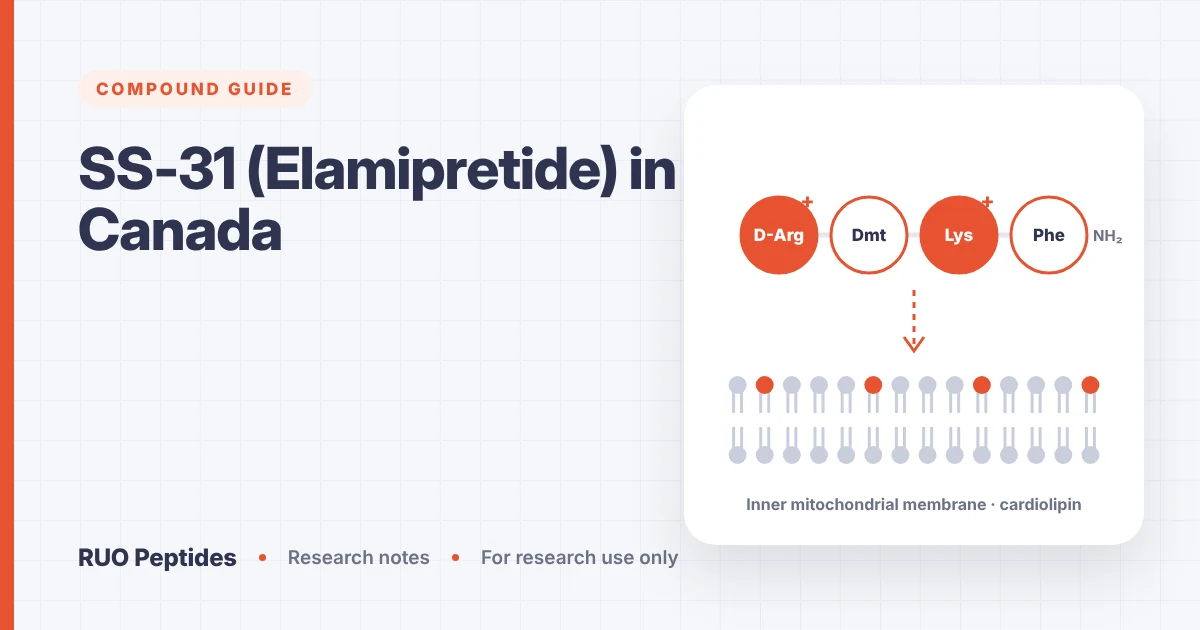
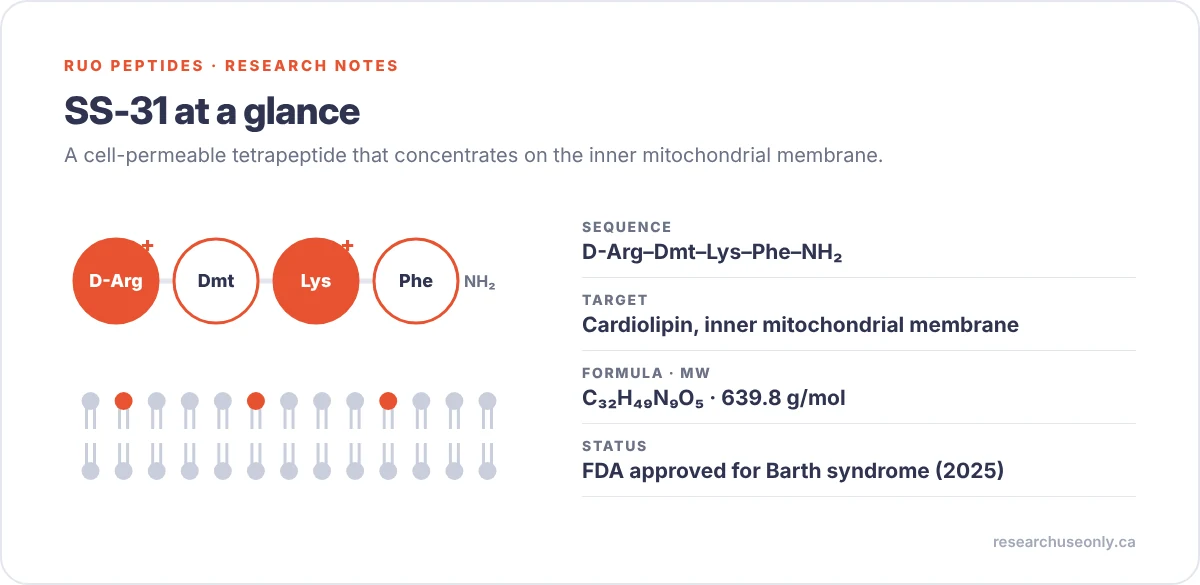
- SS-31 is a four-residue peptide (D-Arg–Dmt–Lys–Phe–NH₂) that targets the inner mitochondrial membrane.
- It binds cardiolipin, a phospholipid that supports cristae structure and the electron transport chain.
- As elamipretide (Forzinity), it received US FDA accelerated approval for Barth syndrome in September 2025.
- Research-use SS-31 is not the approved drug. Check identity, salt form and chirality on the CoA.
SS-31 at a glance
| Other names | Elamipretide, MTP-131, Bendavia; Forzinity (approved product) |
| Class | Aromatic-cationic, mitochondria-targeted tetrapeptide (Szeto-Schiller peptide) |
| Sequence | D-Arg–Dmt–Lys–Phe–NH₂ (Dmt = 2′,6′-dimethyltyrosine) |
| Molecular formula | C32H49N9O5 |
| Molecular weight | 639.8 g/mol (free base) |
| CAS number | 736992-21-5 |
| Target | Cardiolipin in the inner mitochondrial membrane |
| Developer | Stealth BioTherapeutics |
How SS-31 interacts with mitochondria
SS-31 belongs to the Szeto-Schiller family of peptides, named after Hazel Szeto and Peter Schiller, who first described them. Its alternating pattern of aromatic residues (Dmt, Phe) and positively charged residues (D-Arg, Lys) gives it a net positive charge at physiological pH while still allowing it to cross cell membranes. The D-arginine at the N-terminus makes it more resistant to breakdown by enzymes than an all-L peptide.
Once inside the cell, SS-31 concentrates on the inner mitochondrial membrane, where it binds cardiolipin. Cardiolipin is a phospholipid found almost only in this membrane. It helps shape the cristae and holds together the protein complexes of the electron transport chain. Research on SS-31 has focused on three linked effects:
- Membrane stabilization: binding cardiolipin is thought to help preserve cristae structure and the organisation of respiratory complexes.
- Cytochrome c: the SS-31–cardiolipin interaction limits the peroxidase activity of cytochrome c, which otherwise oxidizes cardiolipin under stress.
- Bioenergetics: in cell and animal models, these effects have been linked to better ATP production and lower formation of reactive oxygen species.
From SS-31 to elamipretide
Stealth BioTherapeutics developed SS-31 clinically under the name elamipretide. Its clinical path has had both setbacks and a landmark approval:
- Barth syndrome: in September 2025 the FDA granted accelerated approval to Forzinity (elamipretide) for Barth syndrome in patients weighing at least 30 kg. It was the first approved treatment for this rare inherited cardiolipin disorder. The approval was based on improved knee-extensor muscle strength in the open-label portion of the TAZPOWER trial, and a confirmatory trial is required.
- Regulatory history: the approval followed an NDA that was not accepted in 2021 and a rejection in May 2025, despite a positive FDA advisory committee vote in October 2024.
- Primary mitochondrial myopathy: the Phase 3 MMPOWER-3 trial did not meet its primary endpoints. Later analyses explored whether patients with specific genetic causes responded differently.
- Dry age-related macular degeneration: elamipretide is being studied in the Phase 3 ReNEW trial in dry AMD.
What a CoA should confirm
SS-31 is short, but its non-standard building blocks make identity checks more specific than for a typical peptide. Look for:
- Mass spectrometry identity close to the expected monoisotopic mass of about 639.4 Da, usually seen as [M+H]⁺ near 640.4. A mass about 14 Da lower can indicate tyrosine in place of Dmt.
- HPLC purity with the chromatogram, not only a percentage.
- Salt form and peptide content. SS-31 is commonly supplied as an acetate or TFA salt, so the gross vial weight is higher than the weight of peptide alone.
- Chirality. Standard HPLC and MS cannot tell D-Arg from L-Arg. For work where stereochemistry matters, ask whether chiral analysis or synthesis records are available.
- A lot number that matches the vial.
For how these tests work together, see HPLC Purity vs. Mass Spec Identity and How to Read a Peptide Certificate of Analysis.

Canadian regulatory context
Forzinity’s approval is a US FDA decision and does not by itself authorize elamipretide for sale in Canada. In Canada, peptides with therapeutic use are generally regulated as prescription drugs. Health Canada’s April 2026 advisory on unauthorized injectable peptides states that labels such as “For Research Use Only – Not for Human Consumption” do not make a product legal for personal use or exempt it from drug regulations.
Frequently asked questions
Is SS-31 the same as elamipretide?
They share the same peptide sequence. Elamipretide is the name used for clinical development, and Forzinity is the approved drug product. Research-use SS-31 is not manufactured or tested to the same standards as the approved drug.
Is elamipretide approved in Canada?
Its 2025 approval for Barth syndrome was granted by the US FDA. That decision does not authorize the drug in Canada.
How should lyophilized SS-31 be stored?
Keep vials sealed, dry and refrigerated at 2–8 °C, protected from light. See Lyophilized Peptide Storage and Handling for details.
Sources
- FDA accelerated approval of Forzinity, reported by Pharmaceutical Technology (September 2025)
- Elamipretide compound data, Selleck Chemicals
- Genotype-specific effects of elamipretide in primary mitochondrial myopathy, Orphanet Journal of Rare Diseases (2024)
- ReNEW Phase 3 trial in dry AMD, NCT06373731
- Health Canada, advisory on unauthorized injectable peptides (April 2026)