




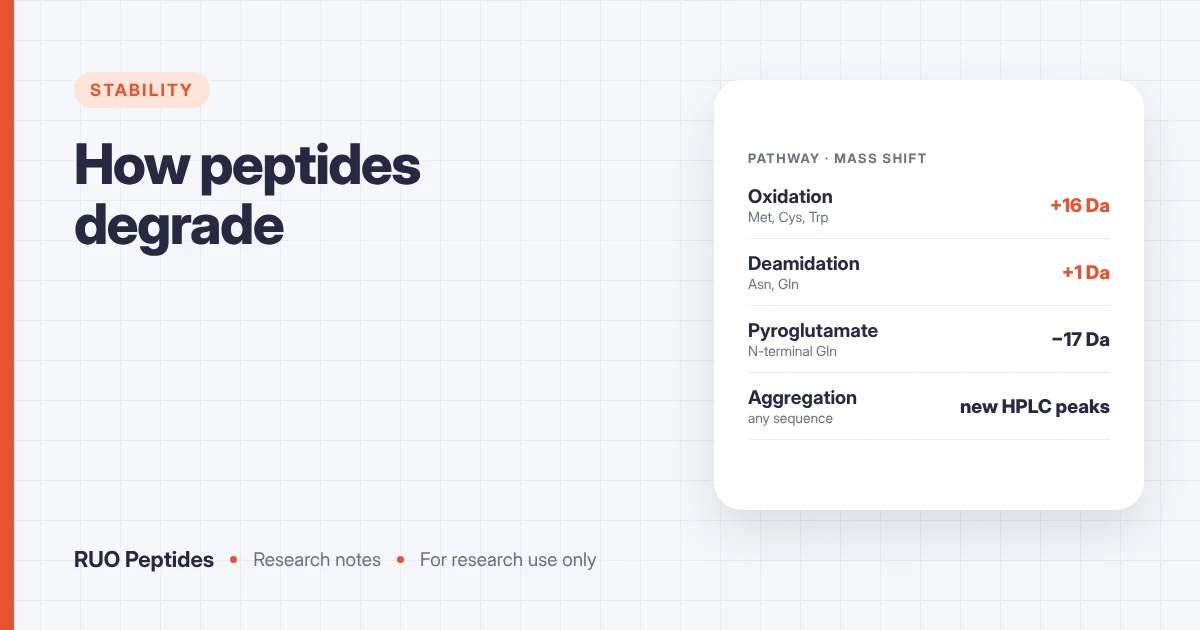
A peptide that passes its CoA on the day it is made can change over time. Small chemical reactions add or remove a few daltons, split the chain or join molecules together. Knowing the common pathways helps you recognize them in HPLC and mass spectrometry data and understand why storage conditions matter.
- Oxidation of methionine adds about 16 Da and is driven by oxygen, light and metal traces.
- Deamidation of asparagine adds only about 1 Da, so it is easy to miss without good MS resolution.
- An N-terminal glutamine can cyclize to pyroglutamate, losing about 17 Da.
- Moisture, heat and pH drive most of these reactions, which is why peptides are stored lyophilized, cold and dry.
Why sequence matters
Degradation is not random. It happens at particular residues and particular neighbours. A sequence with methionine, an asparagine followed by glycine, an N-terminal glutamine or an aspartate followed by proline has known weak points. Reading a sequence with these in mind tells you which changes to look for in the data.
Oxidation
Methionine is the residue most prone to oxidation. Its sulfur atom picks up an oxygen to form methionine sulfoxide, adding 16 Da to the mass. Cysteine, tryptophan and histidine can also oxidize. Oxygen in the headspace, peroxide traces in solvents, metal ions and light all speed the reaction.
On a reversed-phase HPLC trace, the oxidized form is slightly more polar and often appears as a separate peak eluting just before the main peak. In mass spec data it shows as a signal about 16 Da above the expected mass, or about 8 m/z above it for a doubly charged ion. Our Semax guide gives a worked example.
Deamidation
Asparagine can lose its side-chain amide, forming a five-membered succinimide ring that then opens to aspartic acid or isoaspartic acid. Glutamine does the same, but much more slowly. The net change is about +0.98 Da.
Deamidation is fastest when asparagine is followed by a small residue, especially glycine. In proteins and peptides, Asn-Gly sites can have a half-life of about a day at pH 7.4 and 37 °C, and the reaction speeds up at higher pH and temperature. A 2012 study of a model peptide stored as a lyophilized solid found the succinimide could also produce D-amino acid forms and covalent adducts with neighbouring peptides (DeHart and Anderson, Pharmaceutical Research).
Other common pathways
- Pyroglutamate formation. An N-terminal glutamine can cyclize onto its own side chain, releasing ammonia and losing about 17 Da. An N-terminal glutamate can do the same with loss of water (about 18 Da).
- Hydrolysis. Peptide bonds next to aspartate, particularly Asp-Pro, are relatively easy to cleave, especially under acidic conditions. The result is two or more fragments with lower masses.
- Disulfide changes. Free cysteines can pair up to form dimers, and existing disulfides can rearrange. Dimers show up at about twice the mass.
- Aggregation. Some sequences, especially hydrophobic or amyloid-prone ones, stick together into larger species. These may elute late, fail to elute or simply reduce the main peak.
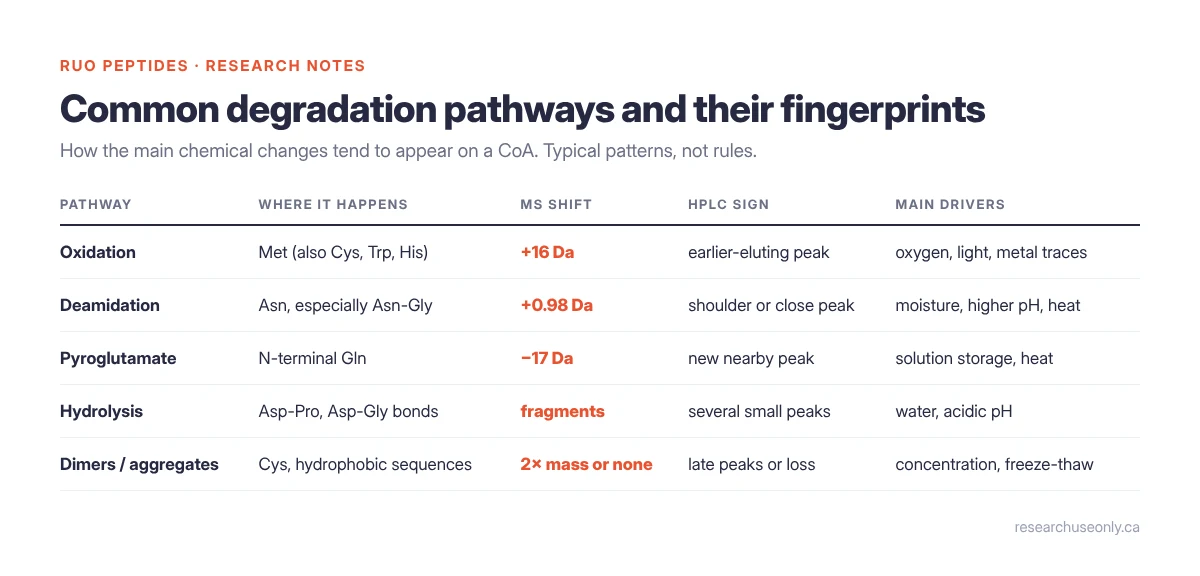
| Pathway | Typical sites | MS shift |
| Oxidation | Met, Cys, Trp, His | +16 Da |
| Deamidation | Asn (esp. Asn-Gly), Gln | +0.98 Da |
| Pyroglutamate | N-terminal Gln | −17 Da |
| Hydrolysis | Asp-Pro, Asp-Gly bonds | Fragments |
| Dimerization | Cys | ≈ 2× mass |
What slows degradation
Water is a reactant or a facilitator in most of these pathways. Freeze-drying removes most of it, which is the main reason peptides are shipped and stored as lyophilized powders. Residual moisture, heat, light and oxygen remain the main risks.
- Keep vials sealed, cold and dry until use, and let them reach room temperature before opening to avoid condensation.
- Protect from light, especially for sequences with tryptophan or methionine.
- Minimize time in solution and avoid repeated freeze-thaw of prepared stocks.
- Re-check identity and purity on older material before relying on it for critical work.
Our Lyophilized Peptide Storage and Handling guide covers these points in more detail.
Frequently asked questions
What does a peak 16 Da above the expected mass mean?
It usually indicates a single oxidation, most often of methionine. Two oxidations would add about 32 Da.
Can deamidation be seen on mass spec?
Sometimes. It adds only about 1 Da, so it can overlap with the natural isotope pattern. High-resolution MS or HPLC separation of the deamidated species makes it easier to detect.
Why are peptides supplied lyophilized?
Removing water slows hydrolysis, deamidation and other reactions that need water, so the powder is much more stable than a solution.
Which residues are most vulnerable?
Methionine and cysteine for oxidation, asparagine for deamidation, N-terminal glutamine for pyroglutamate formation, and aspartate next to proline for chain cleavage.
Sources
- Deamidation mechanism, mass shift and Asn-Gly rates, Wikipedia
- DeHart MP, Anderson BD. Kinetics and mechanisms of deamidation and covalent amide-linked adduct formation in amorphous lyophiles of a model asparagine-containing peptide. Pharm Res. 2012;29:2722–2737. Springer
Related reading
Browse the catalogue: see the current research peptides available in Canada, each listed with amount, purity and storage details. For research use only.