


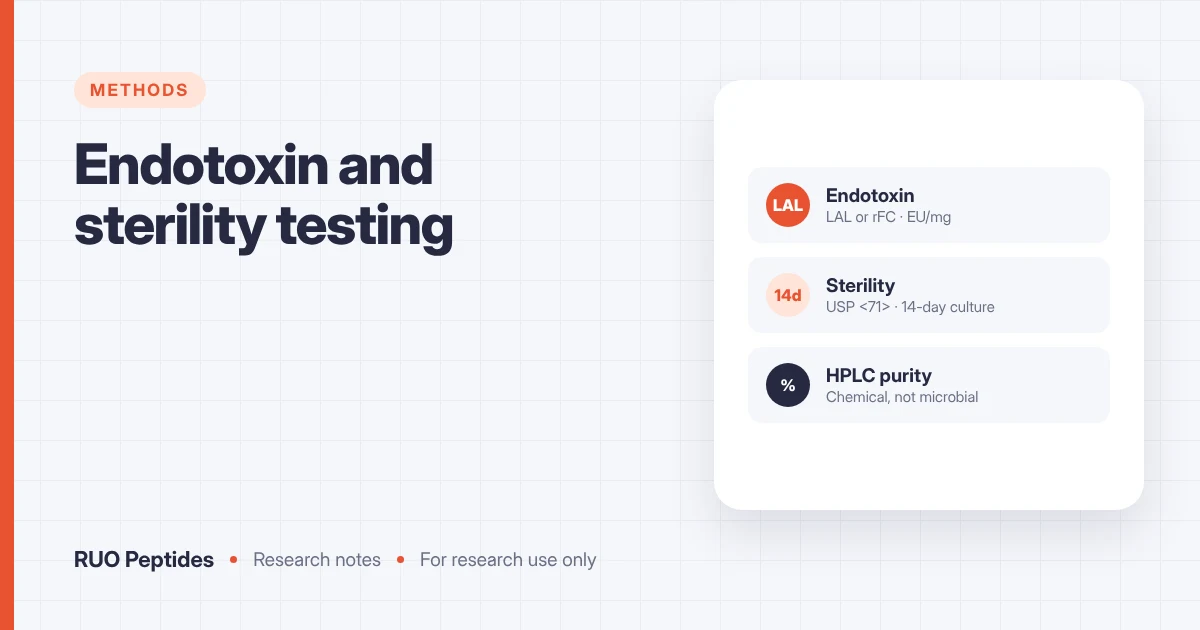
A research peptide CoA usually reports identity by mass spectrometry and purity by HPLC. Those tests are chemical. They say nothing about bacterial endotoxin or living microorganisms. For many experiments that does not matter, but for cell-based and immunology work it can. This guide explains what endotoxin and sterility tests measure and how to read them.
- Endotoxin is lipopolysaccharide (LPS) from the outer membrane of gram-negative bacteria. It is measured in endotoxin units (EU).
- Sterility testing asks whether anything is alive in a sample. The standard USP <71> test incubates for 14 days.
- A product can be sterile and still contain endotoxin, because endotoxin survives the processes that kill bacteria.
- Most research-grade peptide CoAs report neither test. Labs doing endotoxin-sensitive work should ask for data or test in-house.
What endotoxin is
Endotoxin is a lipopolysaccharide that forms part of the outer membrane of gram-negative bacteria such as E. coli and Pseudomonas. It is released when bacteria grow or die, and it is biologically active at very low levels.
Endotoxin is also very heat-stable. Standard steam sterilization at 121 °C kills bacteria but does not destroy endotoxin. Removing it from glassware typically requires dry heat at around 250 °C for at least 30 minutes, conditions a finished peptide cannot survive. Endotoxin control therefore depends on clean water, reagents and processing, rather than on a step at the end.
How endotoxin is measured
The standard bacterial endotoxins test uses lysate from horseshoe crab blood cells, known as LAL (Limulus amebocyte lysate). It is described in USP <85> and harmonized with the European and Japanese pharmacopoeias. There are three main formats:
- Gel clot: a pass or fail result based on whether a firm clot forms.
- Turbidimetric: measures cloudiness as the clotting reaction develops. Quantitative.
- Chromogenic: measures a yellow colour released from a synthetic substrate. Quantitative.
Recombinant factor C (rFC) assays replace the crab-derived lysate with a recombinant version of the enzyme that first recognizes endotoxin. Because rFC lacks the factor G pathway, it does not give false positives from beta-glucans. Results are reported in endotoxin units, usually as EU per mg of peptide or EU per vial.
| Method | Result | Notes |
| Gel clot LAL | Pass / fail at a set sensitivity | Simple, widely used |
| Kinetic turbidimetric LAL | EU/mg (quantitative) | Plate-reader based |
| Kinetic chromogenic LAL | EU/mg (quantitative) | Less prone to some interference |
| Recombinant factor C | EU/mg (quantitative) | No horseshoe crab material; no beta-glucan false positives |
What sterility testing shows
Sterility testing looks for viable bacteria and fungi. Under USP <71>, the sample is usually passed through a membrane filter, and the filter is incubated in two growth media for 14 days: fluid thioglycollate medium for anaerobes and many aerobes, and soybean-casein digest medium for fungi and aerobic bacteria. Any growth is a failure unless the test itself is shown to be invalid.
Sterility is a pass or fail result for the batch tested. It does not measure endotoxin, and it says nothing about chemical identity or purity.
Why purity, endotoxin and sterility are separate
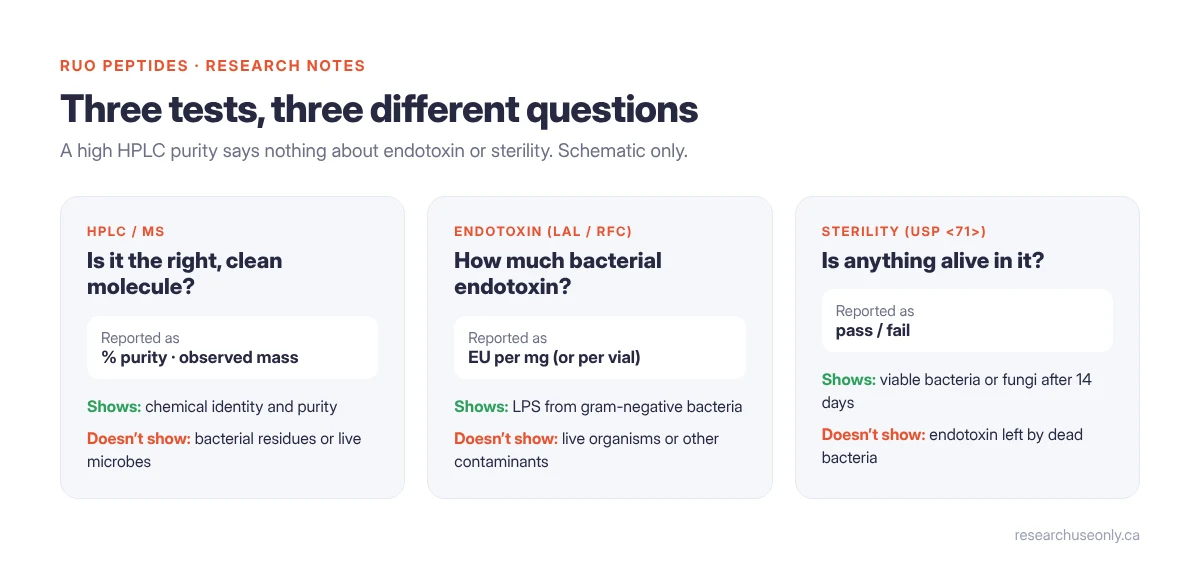
Each test answers a different question, and a good result on one does not imply a good result on another:
- A peptide can be 99% pure by HPLC and still carry endotoxin, because LPS does not appear as a peptide peak.
- A sample can be sterile and still contain endotoxin left behind by bacteria that were killed or filtered out. A 0.22 µm filter removes bacteria but generally not endotoxin.
- A sample can be low in endotoxin and still be the wrong molecule. Identity comes from mass spectrometry.
Reading a research peptide CoA
Most research-grade peptide CoAs, including many from large manufacturers, report identity and purity only. Lyophilized research peptides are generally not supplied as sterile products. If your work is sensitive to endotoxin, for example primary immune cells, cytokine readouts or in-vitro inflammation models, consider:
- Asking the supplier whether lot-specific endotoxin data is available, and by which method.
- Checking the units. A figure in EU/mg needs to be converted to the concentration you will actually use in the assay.
- Testing in-house with a LAL or rFC kit when the readout is critical, and running an LPS-only control.
- Handling aseptically after opening, using endotoxin-free water and consumables for any solutions you prepare.
For the other parts of a CoA, see How to Read a Peptide Certificate of Analysis.
Frequently asked questions
Does high HPLC purity mean a peptide is free of endotoxin?
No. HPLC measures chemical purity of the peptide. Endotoxin is a bacterial lipopolysaccharide and needs its own test, such as LAL or recombinant factor C.
What is an endotoxin unit (EU)?
An EU is a standardized unit of endotoxin activity, referenced to a USP reference standard. Peptide results are usually given per mg or per vial.
Does sterile filtration remove endotoxin?
A 0.22 µm filter removes bacteria but generally does not remove endotoxin. Endotoxin is also stable to normal autoclaving.
Are research peptides sterile?
Lyophilized research peptides are generally not manufactured or tested as sterile products. A sterility claim should be backed by a test result such as USP <71>.
Sources
- Bacterial endotoxins testing, methods and recombinant factor C, Eurofins
- Endotoxin testing overview, units and depyrogenation, Contract Laboratory
- Release testing: sterility (USP <71>) and endotoxin (USP <85>), Open Exam Prep study guide
Related reading
Browse the catalogue: see the current research peptides available in Canada, each listed with amount, purity and storage details. For research use only.