


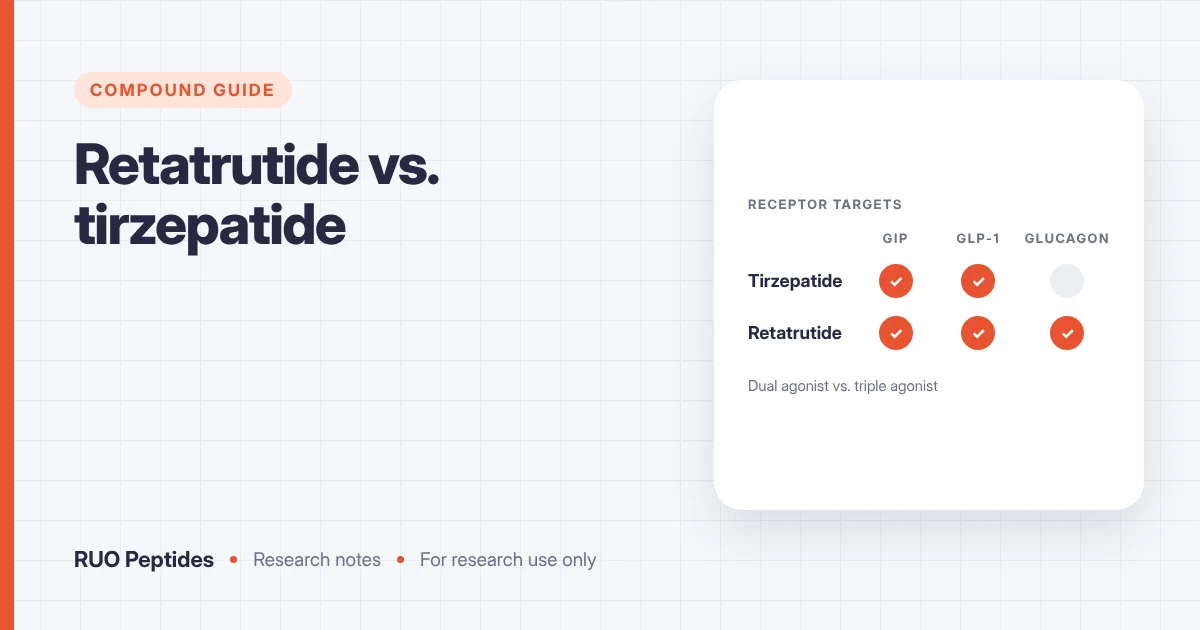
Retatrutide and tirzepatide are both Eli Lilly peptides built on a GIP-like backbone, and both are studied in obesity and type 2 diabetes. The difference is one receptor: tirzepatide activates two incretin receptors, while retatrutide also activates the glucagon receptor. They are also at very different stages. Tirzepatide is an approved medicine; retatrutide is still investigational. This guide compares them as of October 2026.
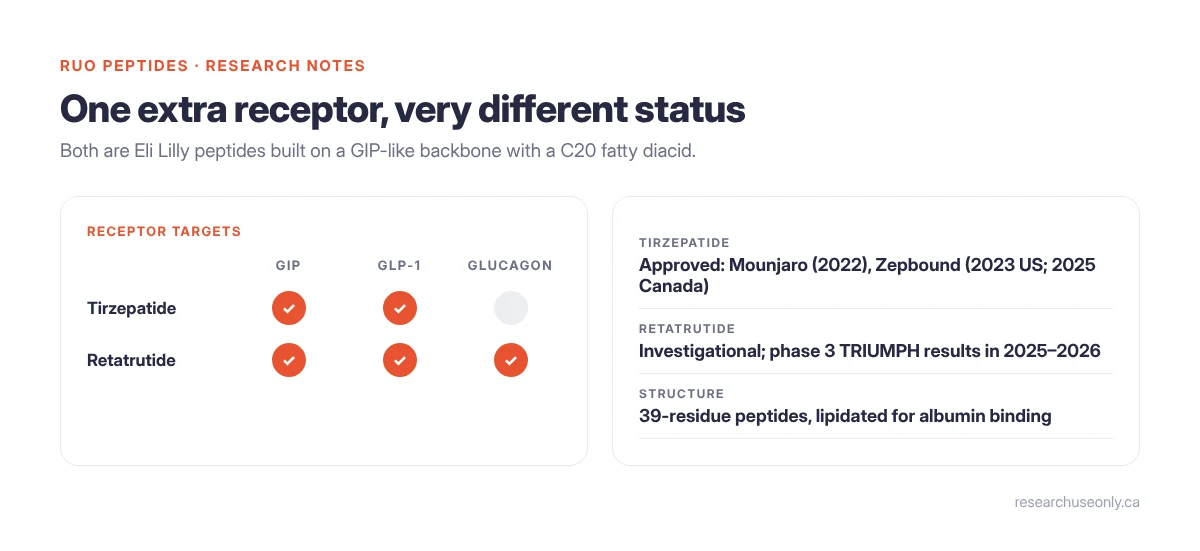
- Tirzepatide is a GIP and GLP-1 receptor dual agonist. Retatrutide is a GIP, GLP-1 and glucagon receptor triple agonist.
- Both are 39-residue lipidated peptides designed to bind albumin and circulate for days.
- Tirzepatide is approved in Canada as Mounjaro (2022) and Zepbound (2025). Retatrutide is not approved anywhere.
- Phase 3 TRIUMPH trials of retatrutide reported in 2025–2026. Lilly has said it plans a US filing in 2027.
At a glance
| Tirzepatide | Retatrutide | |
| Code name | LY3298176 | LY3437943 |
| Receptor targets | GIP, GLP-1 | GIP, GLP-1, glucagon |
| Structure | 39 aa, C20 fatty diacid | 39 aa, C20 fatty diacid |
| Formula | C225H348N48O68 | C221H342N46O68 |
| Approx. MW | 4813 Da | 4731 Da (free base) |
| Status in Canada | Approved (Mounjaro, Zepbound) | Investigational |
How the receptor profiles differ
GLP-1 and GIP are incretin hormones released from the gut after eating. GLP-1 receptor agonists such as semaglutide act on one of these receptors. Tirzepatide acts on both GLP-1 and GIP receptors.
Retatrutide adds the glucagon receptor. Glucagon raises blood glucose but also increases energy expenditure and liver fat breakdown. Combining it with incretin activity is intended to add those effects while the GLP-1 and GIP components offset the glucose-raising action. Whether that balance holds up in long-term use is one of the questions the phase 3 programme is designed to answer.
What the trials report
Tirzepatide: in SURMOUNT-1 (NEJM, 2022), 2,539 adults with obesity and without diabetes lost on average up to 20.9% of body weight at 72 weeks in the highest-dose arm, compared with 3.1% on placebo.
Retatrutide: a 2023 phase 2 trial (NEJM) reported 24.2% average weight loss at 48 weeks in the highest-dose arm. In the phase 3 TRIUMPH-1 trial, published in NEJM in September 2026, the highest-dose arm lost 25.0% at 80 weeks versus 3.9% on placebo, using the treatment-regimen analysis. Lilly’s earlier topline release, using a different analysis, reported 28.3%.
| Trial | Compound | Duration | Mean weight change (highest arm vs placebo) |
| SURMOUNT-1 | Tirzepatide | 72 weeks | Up to 20.9% vs 3.1% |
| Phase 2 (2023) | Retatrutide | 48 weeks | Up to 24.2% |
| TRIUMPH-1 (2026) | Retatrutide | 80 weeks | Up to 25.0% vs 3.9% |
Safety themes: gastrointestinal effects (nausea, vomiting, diarrhea) dominate for both. Retatrutide trials also reported dysesthesia (altered skin sensation), mostly mild, and higher discontinuation for adverse events at the top dose.
What a CoA should confirm
These are large, modified peptides with non-standard residues and a fatty-acid side chain, which makes identity testing important.
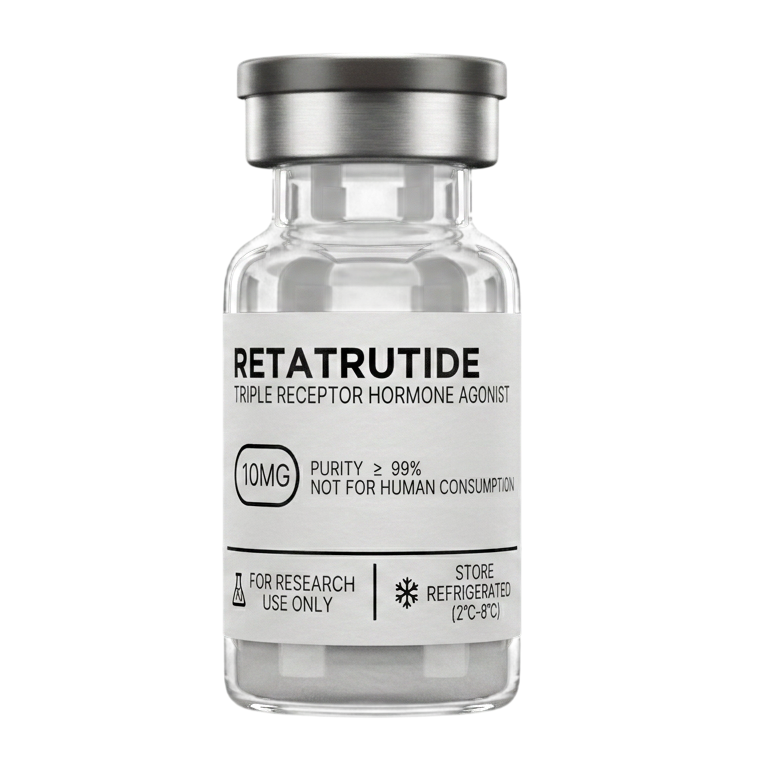
- Mass spectrometry identity close to about 4731 Da for retatrutide (free base), usually seen as multiply charged ions. Salt forms weigh more.
- HPLC purity with the chromatogram. Lipidated peptides can show closely eluting impurities.
- Peptide content and salt form, since counter-ions add measurable weight. See Peptide Content vs. Purity.
Canadian regulatory context
Tirzepatide is a prescription drug in Canada, sold only through licensed pharmacies as Mounjaro and Zepbound. Retatrutide has no Canadian authorization. Health Canada named retatrutide in its April 2026 advisory among seized unauthorized injectable peptides, and warned separately in January 2026 about fake and unauthorized GLP-1 products.
Frequently asked questions
What is the main difference between retatrutide and tirzepatide?
Tirzepatide activates GIP and GLP-1 receptors. Retatrutide activates those two and the glucagon receptor, making it a triple agonist.
Is retatrutide approved in Canada?
No. Retatrutide is investigational and not approved anywhere as of October 2026. Lilly has said it plans to file with the US FDA in 2027.
Is tirzepatide approved in Canada?
Yes. Health Canada authorized Mounjaro for type 2 diabetes in 2022 and Zepbound for chronic weight management in 2025.
Can the trial results be compared directly?
Not reliably. The trials differ in population, length and analysis method, and no head-to-head trial had reported as of October 2026.
Sources
- Health Canada, Mounjaro product monograph and Summary Basis of Decision
- Eli Lilly Canada, Zepbound approved in Canada (2025)
- SURMOUNT-1 summary, American College of Cardiology
- Eli Lilly, TRIUMPH-1 topline results (May 2026) and TRIUMPH-2 and TRIUMPH-3 (July 2026)
- TRIUMPH-1 publication coverage, HCPLive (September 2026)
- Retatrutide compound data, Wikipedia