
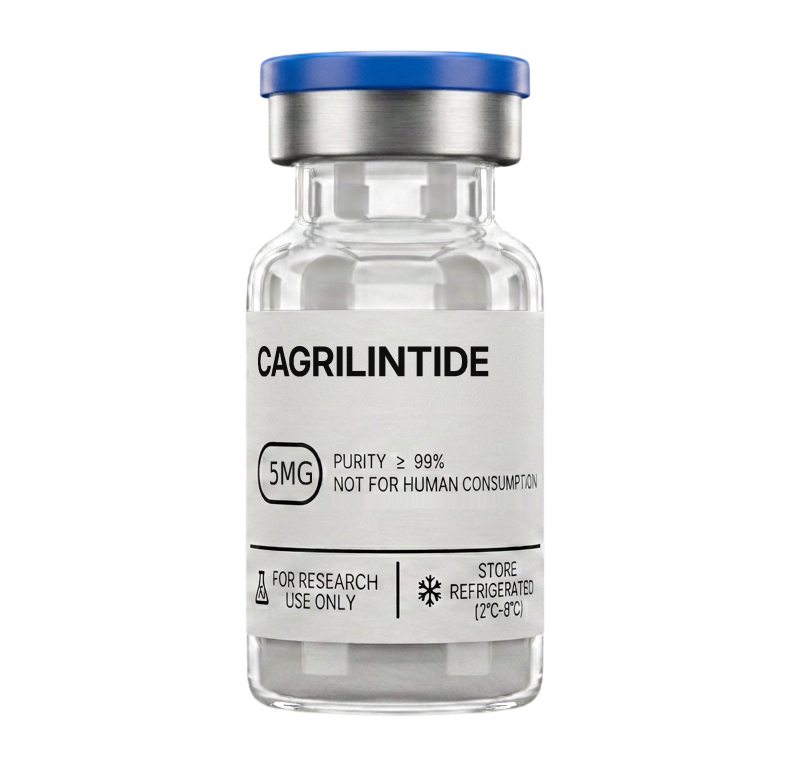
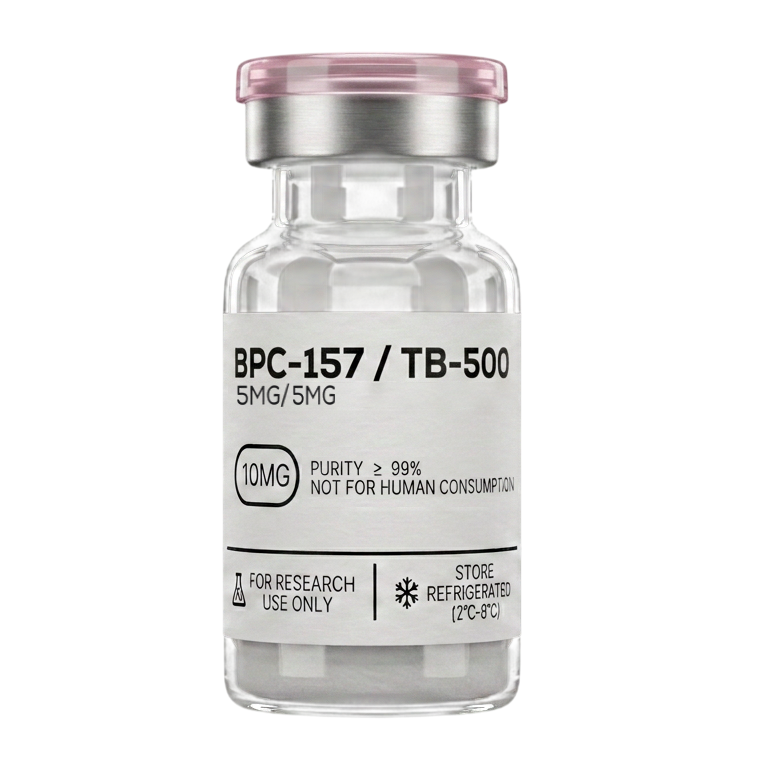


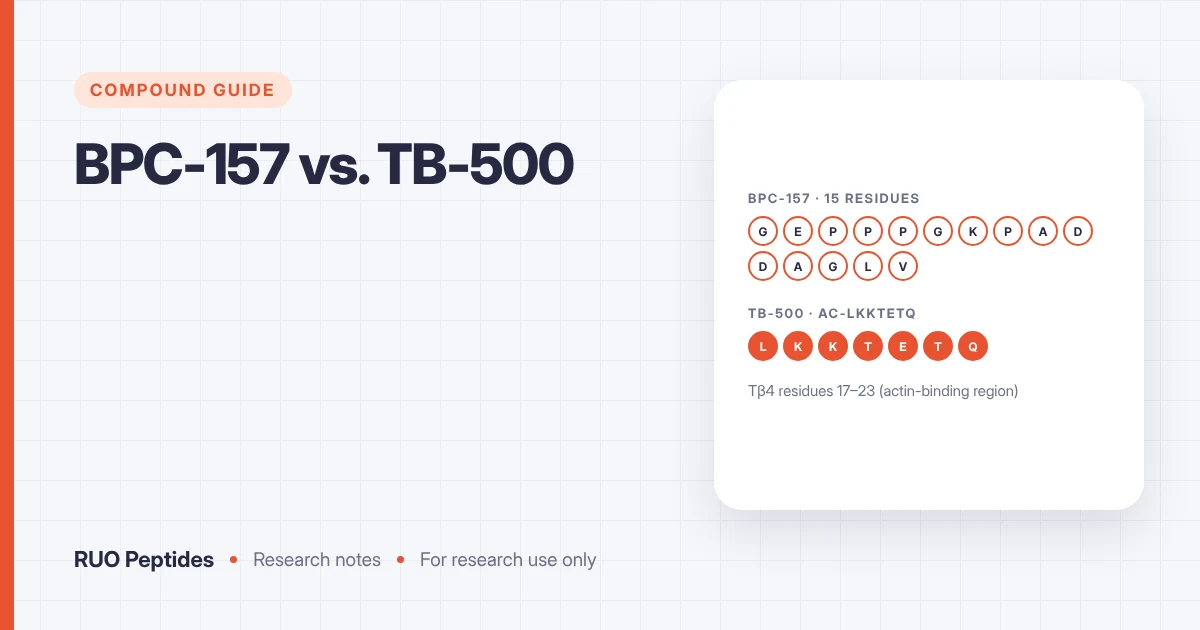
BPC-157 and TB-500 are frequently discussed together and are often sold as a blend, but they are unrelated molecules. One is a fragment of a protein reported in gastric juice. The other is a piece of thymosin beta-4, a small actin-binding protein. This guide compares what each one is, what the research covers, and where they stand with regulators in 2026.
- BPC-157 is a synthetic 15-residue peptide (GEPPPGKPADDAGLV) derived from a gastric “body protection compound”.
- TB-500 usually means Ac-LKKTETQ, residues 17–23 of thymosin beta-4. Commercial use of the name is inconsistent.
- Research on both is mostly preclinical. Neither has completed published clinical trials leading to approval.
- Neither is approved by Health Canada or the FDA. Both are on the WADA prohibited list.
At a glance
| BPC-157 | TB-500 | |
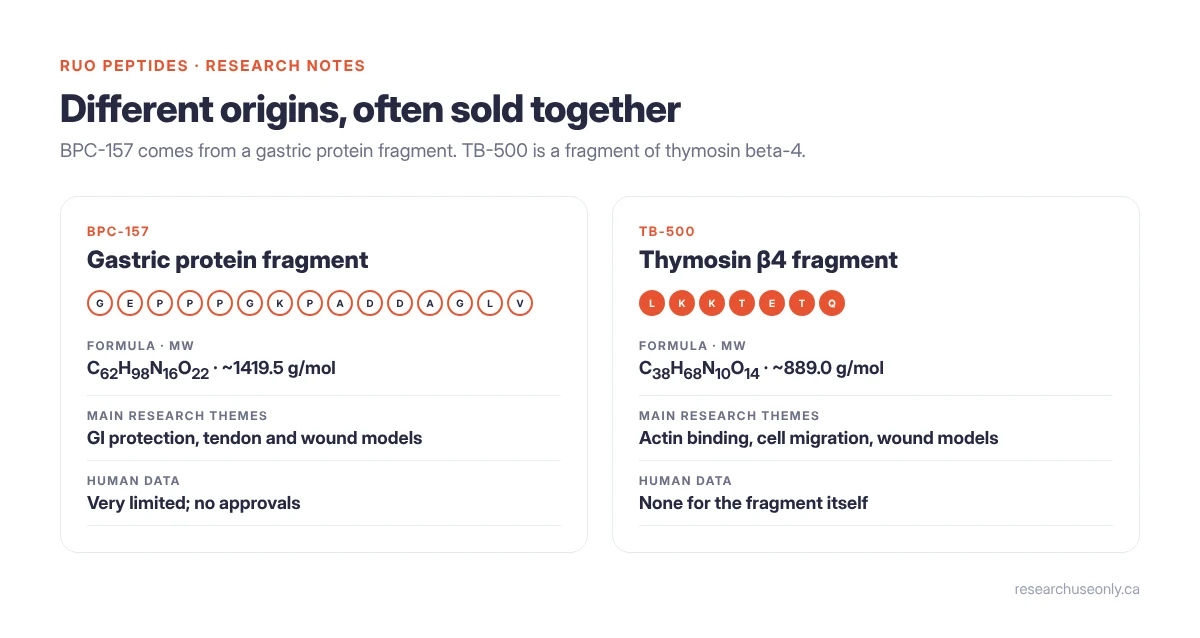
| What it is | Synthetic fragment of a gastric protein | Synthetic fragment of thymosin beta-4 |
| Sequence | GEPPPGKPADDAGLV (15 aa) | Ac-LKKTETQ (7 aa, N-acetylated) |
| Formula | C62H98N16O22 | C38H68N10O14 |
| Approx. MW | 1419.5 g/mol | 889.0 g/mol |
| First described | 1993, Zagreb (Sikiric group) | Fragment of Tβ4, characterized in the 1990s–2000s |
| WADA 2026 | S0 Non-approved substances | S2 Growth factors (Tβ4 and derivatives) |
Where each one comes from
BPC-157 was first published in 1993 by Predrag Sikiric and colleagues in Zagreb as a stable partial sequence of a protein they called “body protection compound”, reported in human gastric juice. It also appears in the literature as bepecin and PL 14736.
TB-500 refers to a synthetic fragment of thymosin beta-4 (Tβ4), a 43-residue protein that binds G-actin and is abundant in many cell types. In the research and anti-doping literature, the name usually means Ac-LKKTETQ, the actin-binding region at residues 17–23. Some products labelled “TB-500” are described as full-length Tβ4, and a different Tβ4 fragment, Ac-SDKP, is sometimes confused with it. Mass spectrometry is the only reliable way to tell which molecule a vial contains.
What the research describes
BPC-157: most studies are in rodents and cover gastrointestinal protection, tendon and ligament healing models, angiogenesis and cytoprotection. Human data are limited to a registered phase I study whose results were never posted and a few small case series. Reviewers have noted a theoretical concern that pro-angiogenic activity could support tumour growth.
TB-500 and Tβ4: Tβ4 itself has been studied in wound healing, corneal repair and cardiac repair models, with effects on cell migration and angiogenesis. Full-length Tβ4 has reached phase 2 and phase 3 trials as an eye-drop formulation (RGN-259) without approval. The Ac-LKKTETQ fragment sold as TB-500 has not been tested in human trials.
What a CoA should confirm
- Separate identity data for each component in a blend: expected and observed mass for BPC-157 (about 1419 Da) and for the TB-500 form actually present.
- A statement of which TB-500 is supplied: Ac-LKKTETQ, full-length Tβ4 or another fragment.
- HPLC purity per component, with the chromatogram showing both peaks resolved.
- Amounts per vial for each peptide and a matching lot number.
Our BPC-157 and TB-500 guide covers blend documentation in more detail.

Regulatory status in 2026
Canada: neither peptide is authorized. Health Canada named both in its April 2026 advisory as examples of seized unauthorized injectable peptides, and stated that research-use-only labels do not make such products legal.
United States: neither is FDA-approved. In July 2026 an FDA advisory committee voted narrowly to recommend both for the compounding bulks list, against the recommendation of FDA staff. The vote is advisory and, as of October 2026, FDA had not acted on it.
Sport: WADA lists BPC-157 under S0 (non-approved substances) and thymosin beta-4 and its derivatives, including TB-500, under S2. Both are prohibited at all times.
Frequently asked questions
Are BPC-157 and TB-500 related?
No. BPC-157 is derived from a gastric protein, while TB-500 is a fragment of thymosin beta-4. They are often combined commercially but have unrelated sequences and origins.
What exactly is TB-500?
In research and anti-doping literature it usually means Ac-LKKTETQ, the actin-binding region of thymosin beta-4. Products using the name are not always consistent, so check the mass on the CoA.
Is BPC-157 approved anywhere?
No regulator has approved BPC-157. Human evidence is limited to small reports and an unpublished phase I study.
Did the FDA approve BPC-157 or TB-500 in 2026?
No. An FDA advisory committee voted in July 2026 to recommend both for the compounding bulks list, but that vote is not an approval and FDA had not acted on it as of October 2026.
Sources
- BPC-157 overview and history, Wikipedia; compound data, Cayman Chemical
- TB-500 and thymosin beta-4, Wikipedia (TB-500) and Wikipedia (Thymosin beta-4)
- RGN-259 phase 3 trials, ARISE-2 and ARISE-3
- US FDA, Pharmacy Compounding Advisory Committee, July 23–24, 2026; reporting by PharmExec
- Health Canada, advisory on unauthorized injectable peptides (April 2026)
- USADA, BPC-157 prohibited status