
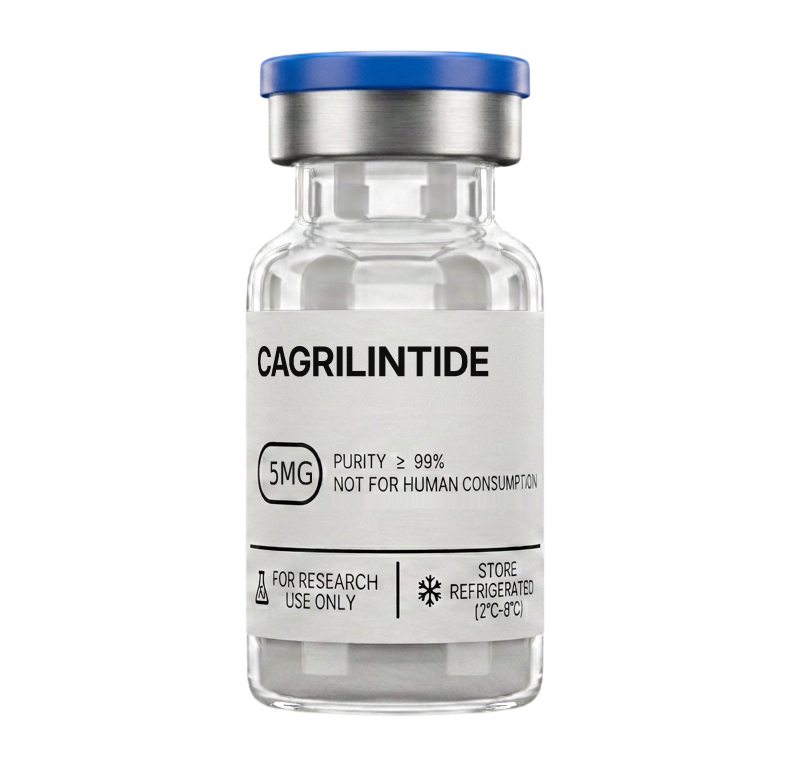
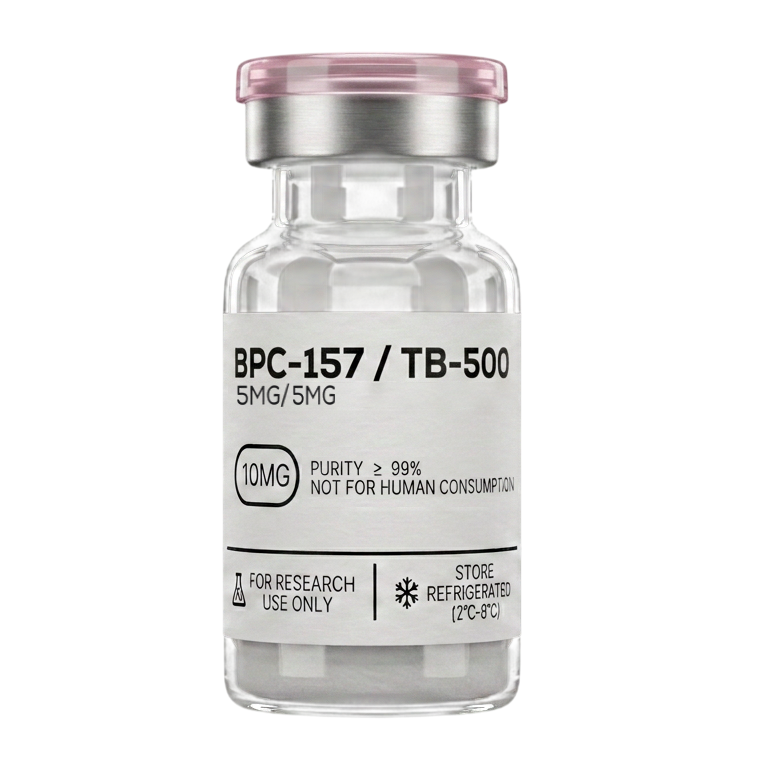



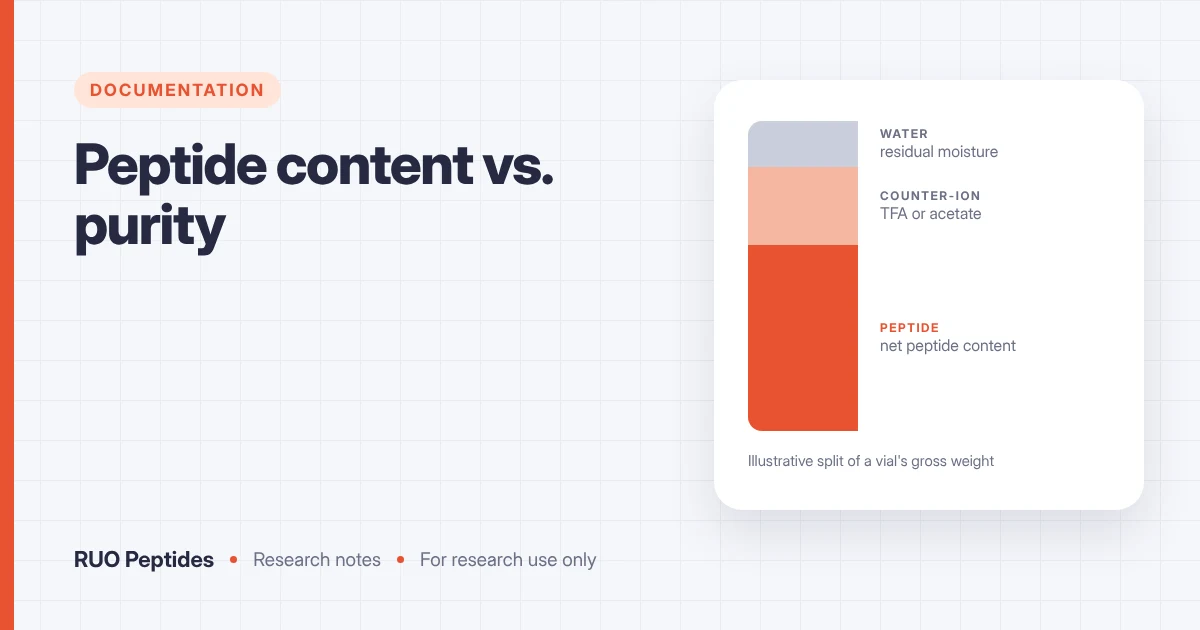
A vial labelled 10 mg holds 10 mg of lyophilized powder, but not all of that powder is the peptide. Part of it is counter-ions left over from synthesis and part is water. Two different numbers describe this: HPLC purity and net peptide content. They are easy to confuse, and they answer different questions.
- HPLC purity is the share of the peptidic material that is the target sequence. It does not see salts or water.
- Net peptide content (NPC) is the share of the total powder weight that is peptide.
- Most synthetic peptides are supplied as TFA or acetate salts, and the counter-ion adds weight.
- The mass of target peptide is roughly gross weight × NPC × purity.
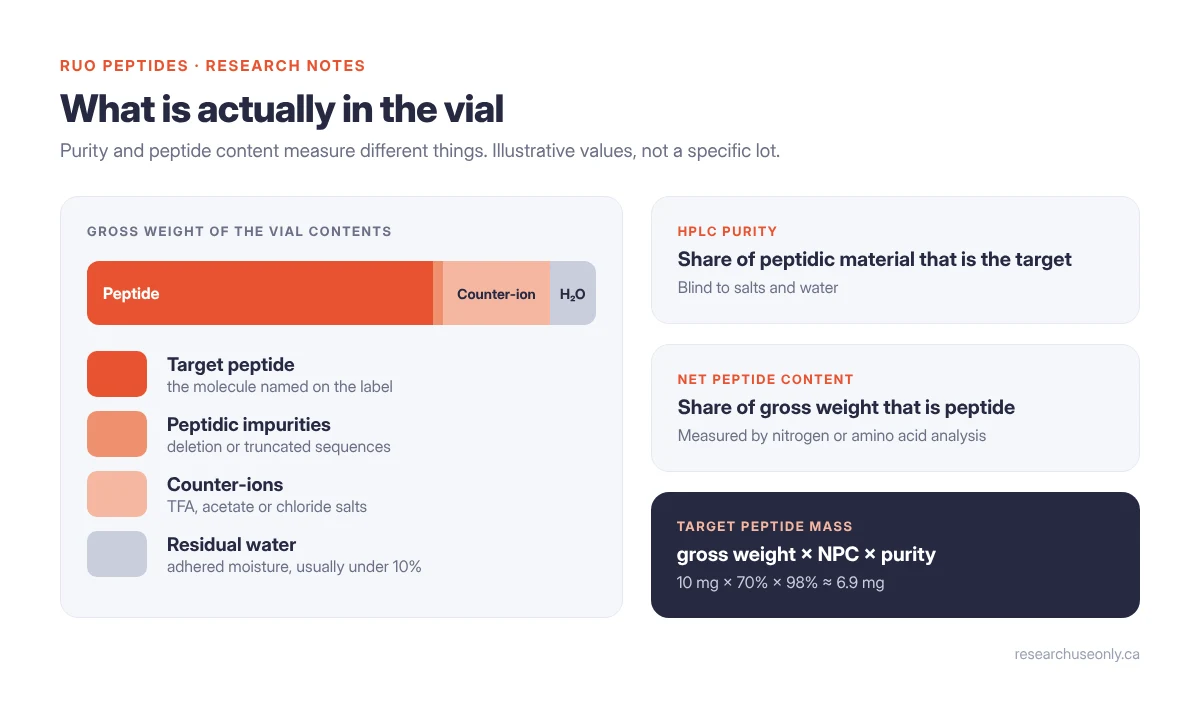
What is in a lyophilized peptide powder
The gross weight of a lyophilized peptide is made up of four things:
- The target peptide, the sequence named on the label.
- Peptidic impurities, mostly deletion or truncated sequences left over from solid-phase synthesis.
- Counter-ions, the negatively charged ions paired with the peptide’s basic groups. Trifluoroacetate (TFA), acetate and chloride are the most common.
- Residual water that stays bound to the powder after freeze-drying.
The first two together make up the “net peptide”. The last two are non-peptide weight. A vial can be very pure and still contain a meaningful share of counter-ion and water.
HPLC purity: a ratio within the peptide
HPLC purity compares the area of the main peak with the total area of all peaks detected, usually at around 214 to 220 nm where peptide bonds absorb. Bachem describes it as the percentage of the requested peptide relative to all material absorbing at 220 nm.
Counter-ions and water do not show up as peptide peaks, so they are invisible to this measurement. A 99% HPLC result means 99% of the peptidic signal is the target. It does not mean 99% of the powder is peptide. For more on what HPLC can and cannot show, see HPLC Purity vs. Mass Spec Identity.
Net peptide content: a ratio of the whole powder
Net peptide content is the share of the gross weight that is peptidic material. It is measured in one of two main ways:
- Elemental nitrogen analysis. Counter-ions such as acetate and TFA and water contain no nitrogen, so the nitrogen content of the sample can be converted into a peptide content.
- Amino acid analysis (AAA). The peptide is hydrolysed into its amino acids, which are then quantified and compared with the expected sequence.
Counter-ion content can be measured separately by ion chromatography, and water by Karl Fischer titration. GenScript technical material describes the target peptide as usually 50 to 80% of gross weight, with water usually under 10% and counter-ion making up much of the rest. The figure varies with the sequence.
| Measure | Question it answers | How it is measured | Blind to |
| HPLC purity | Is the peptide the right sequence, without related impurities? | Peak area at ~220 nm | Salts and water |
| Net peptide content | How much of the powder is peptide? | Nitrogen analysis or AAA | Which peptide it is |
Why counter-ions add weight
Peptides made by solid-phase synthesis are cleaved from the resin and purified using trifluoroacetic acid. The basic groups on the peptide, such as the N-terminus and arginine, lysine and histidine side chains, end up protonated and paired with TFA. The peptide is therefore usually delivered as a TFA salt unless it is exchanged to acetate or chloride.
Each TFA ion weighs about 114 Da. For a 1,500 Da peptide carrying four TFA ions, the counter-ion accounts for roughly 23% of the salt’s weight (456 ÷ 1,956). Short peptides with several basic residues carry proportionally more counter-ion, which is why Bachem notes that arginine-rich peptides tend to have lower peptide content.
Putting the numbers together
When a CoA gives both values, the approximate mass of target peptide in a vial is:
| Formula | Gross weight × net peptide content × HPLC purity |
| Example | 10 mg × 0.70 × 0.98 ≈ 6.9 mg of target peptide |
| Bachem example | 5 mg bradykinin acetate × 0.85 × 0.987 ≈ 4.2 mg |
This matters when a protocol depends on molar concentration. A stock prepared on gross weight alone will be more dilute than intended. Many labs therefore record the net peptide content from the CoA, or quantify the stock directly, before calculating concentrations.
When you review a CoA, check whether it reports a peptide content figure, what salt form it lists, and whether the stated vial amount refers to gross powder or net peptide. If those details are missing, ask the supplier. Our guide on how to read a peptide CoA covers the other fields.
Frequently asked questions
Does 99% purity mean 99% of the vial is peptide?
No. HPLC purity is measured within the peptidic material only. Counter-ions and water are not counted, so the share of the powder that is peptide is usually lower.
What is a typical net peptide content?
It depends on the sequence and salt form. Technical material from peptide manufacturers commonly cites target peptide at roughly 50 to 80% of gross weight.
What is the difference between TFA and acetate salts?
Both are counter-ions paired with the peptide. TFA comes from synthesis and purification. Acetate is often produced by an exchange step and is preferred for some cell-based work. The two weigh different amounts, so the salt form changes the weight per mole.
Why is net peptide content not on every CoA?
It needs an extra test such as nitrogen analysis or amino acid analysis. Many research-grade CoAs report only HPLC purity and mass spec identity.
Sources
- Net peptide content and HPLC purity definitions, Bachem
- Components of a peptide sample, counter-ions and water (AccuPep QC webinar), GenScript
- Peptide quality control services, GenScript
Related reading
Browse the catalogue: see the current research peptides available in Canada, each listed with amount, purity and storage details. For research use only.