




Growth hormone-releasing hormone (GHRH) is a 44-residue hypothalamic peptide, and its first 29 residues carry most of its activity. Several research and pharmaceutical peptides are built from it. Two of them, tesamorelin and CJC-1295, were developed by Montréal companies, and their names are often confused online with sermorelin and “CJC-1295 without DAC”.
This guide compares their structures, explains what each modification is meant to do, and summarizes their regulatory history.
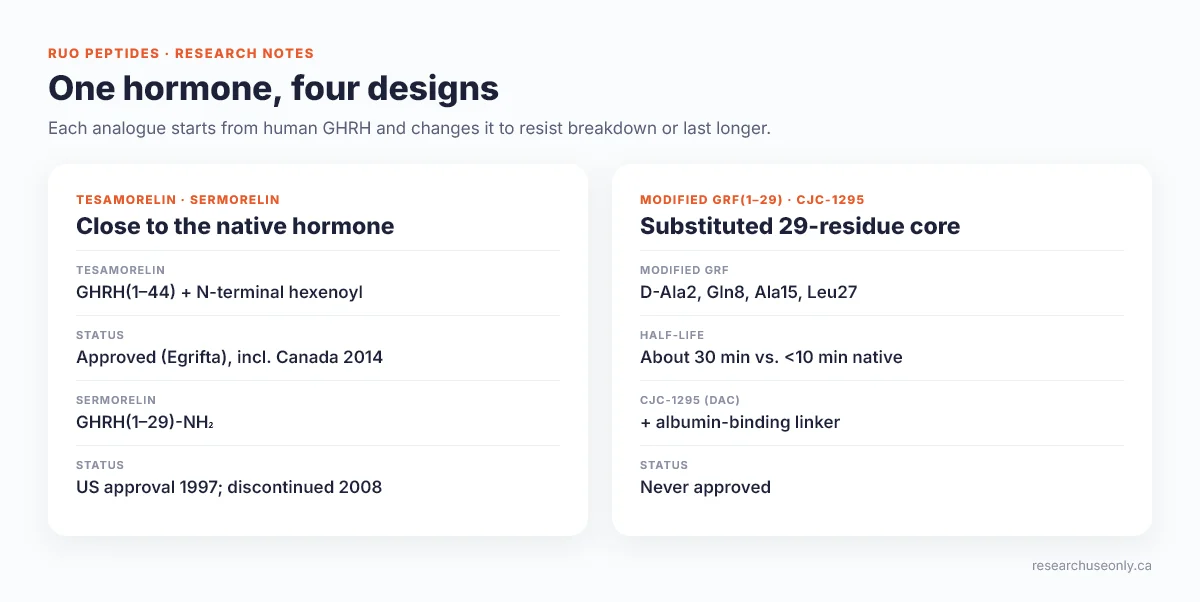
- Tesamorelin is full-length GHRH(1–44) with an N-terminal trans-3-hexenoyl group. As Egrifta it is approved in the US (2010) and Canada (2014) for a specific HIV-related indication.
- Sermorelin is GHRH(1–29)-NH₂. It was approved in the US in 1997 and discontinued in 2008 for commercial reasons.
- Modified GRF(1–29) has four substitutions that resist enzymatic cleavage. CJC-1295 adds an albumin-binding linker that extended half-life to about 6–8 days. Neither was approved.
- “CJC-1295” and “CJC-1295 without DAC” are different molecules. Check the exact structure on any CoA.
The four analogues at a glance
| Analogue | Structure | Origin | Status |
|---|---|---|---|
| Tesamorelin | GHRH(1–44)-NH₂ with N-terminal trans-3-hexenoyl group | Theratechnologies (Montréal) | Approved as Egrifta: US 2010, Canada 2014 |
| Sermorelin | GHRH(1–29)-NH₂ | Serono (Geref) | US approval 1997; production stopped 2008 |
| Modified GRF(1–29) | GHRH(1–29) with D-Ala2, Gln8, Ala15, Leu27 | Research compound | Not approved |
| CJC-1295 (with DAC) | Modified GRF(1–29) + lysine with maleimidopropionyl linker | ConjuChem (Montréal) | Reached Phase 2; not approved |
Why native GHRH needs modifying
Native GHRH is cleared within minutes. The main weak point is the N-terminus: the enzyme DPP-4 cuts between residues 2 and 3, removing the part of the molecule needed to activate the receptor. Native GHRH also contains a methionine at position 27 that can oxidize. Each analogue addresses these problems differently:
- Tesamorelin keeps the full 44-residue sequence and caps the N-terminus with a hexenoyl group, which protects it from DPP-4.
- Sermorelin is simply the active 1–29 fragment with a C-terminal amide. It is no more stable than the native hormone.
- Modified GRF(1–29) swaps in D-alanine at position 2 to block DPP-4, plus substitutions at 8, 15 and 27 to reduce other degradation, including replacing the oxidation-prone Met27 with leucine. Its half-life is about 30 minutes, against under 10 minutes for the unmodified fragment.
- CJC-1295 (with DAC) adds a reactive linker that binds covalently to serum albumin after administration, so the peptide circulates with albumin.
Tesamorelin
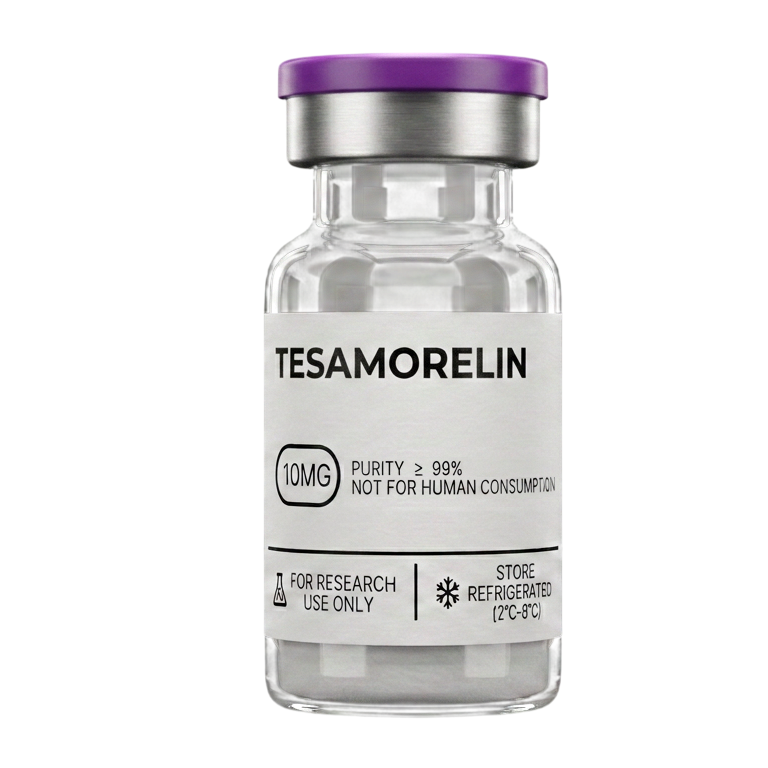
Tesamorelin was developed by Theratechnologies of Montréal. The US FDA approved it as Egrifta in November 2010 to reduce excess abdominal fat in adults with HIV-associated lipodystrophy. Health Canada issued a Notice of Compliance for Egrifta (tesamorelin acetate) in April 2014 for excess visceral fat in treatment-experienced adults with HIV-associated lipodystrophy. In the US, a newer formulation, Egrifta WR, was approved in March 2025.
For its chemistry and documentation, see our tesamorelin compound guide.
Sermorelin
Sermorelin was approved by the US FDA in 1997 as Geref for growth hormone deficiency in children. Production stopped in 2008 for commercial reasons, and the FDA later determined that it had not been withdrawn for safety or effectiveness reasons. Because it is the plain 1–29 fragment, it is often used as a reference point for the modified analogues.
CJC-1295 and modified GRF(1–29)
CJC-1295 was developed by ConjuChem, another Montréal company, using its drug affinity complex (DAC) technology. In a 2006 study in healthy adults published in the Journal of Clinical Endocrinology & Metabolism, CJC-1295 had a half-life of about 5.8 to 8.1 days, and single doses raised growth hormone and IGF-1 levels for a week or more. Clinical development stopped at Phase 2 and the compound was never approved.
What a CoA should confirm
- Exact identity. These analogues have closely related sequences. Mass spectrometry should match the specific structure, including any N-terminal group or linker.
- For tesamorelin: a mass consistent with about 5,136 g/mol. The hexenoyl group adds about 96 Da to the native sequence, so its absence is detectable. Tesamorelin keeps Met27, so oxidized forms at about +16 Da are worth checking.
- HPLC purity with the chromatogram, since deletion sequences of long peptides can elute close to the main peak.
- Peptide content and salt form. Tesamorelin is commonly an acetate salt.
Canadian regulatory context
Of the four, only tesamorelin is an approved drug in Canada, as the prescription product Egrifta. We could not find a Health Canada authorization for sermorelin, modified GRF(1–29) or CJC-1295. GHRH and its analogues are also on the World Anti-Doping Agency’s prohibited list. Health Canada’s April 2026 advisory states that research-use-only labels do not make unauthorized products legal for personal use.
Frequently asked questions
Is CJC-1295 the same as modified GRF(1–29)?
No. Modified GRF(1–29) is the 29-residue peptide with four substitutions. CJC-1295 with DAC is that peptide plus an albumin-binding linker, which extends its half-life from minutes to days. “CJC-1295 without DAC” is a market name for modified GRF(1–29).
Is tesamorelin approved in Canada?
Yes. Health Canada approved Egrifta (tesamorelin acetate) in 2014 as a prescription drug for a specific indication in adults with HIV-associated lipodystrophy. Research-grade tesamorelin is not the approved product.
Why is sermorelin no longer sold as a drug?
Production of Geref stopped in 2008 for commercial reasons. The FDA later determined that it was not withdrawn for safety or effectiveness reasons.
Sources
- FDA approval of Egrifta (tesamorelin), Fierce Pharma (November 2010)
- Health Canada, Summary Basis of Decision for Egrifta (2014)
- Theratechnologies, FDA approval of Egrifta WR (March 2025)
- Sermorelin history, Wikipedia
- Teichman SL et al., “Prolonged stimulation of growth hormone and IGF-I secretion by CJC-1295”, Journal of Clinical Endocrinology & Metabolism (2006)
- CJC-1295 and modified GRF(1-29), Wikipedia and Wikipedia
- Health Canada, advisory on unauthorized injectable peptides (April 2026)