
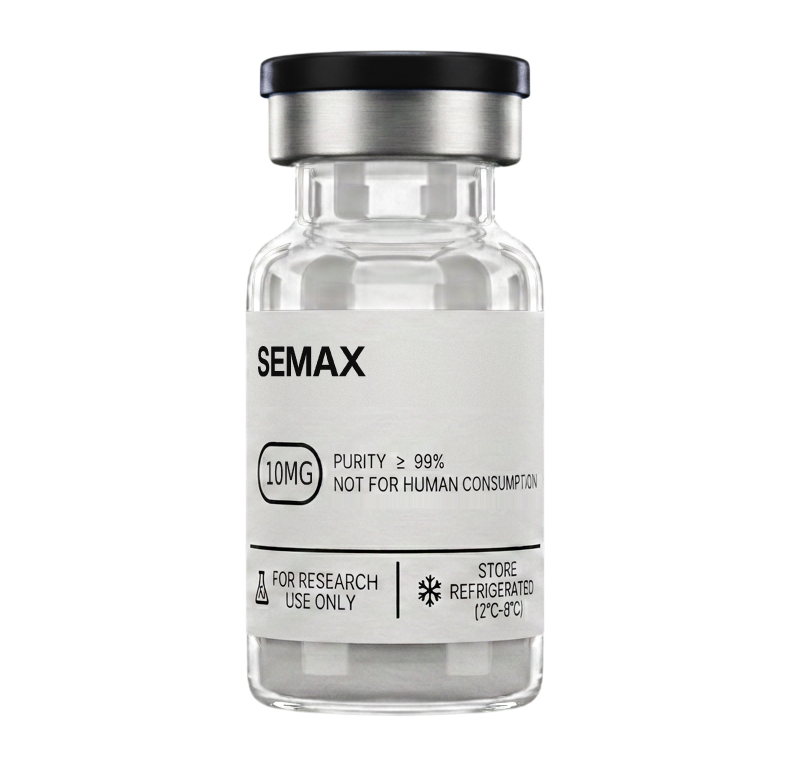
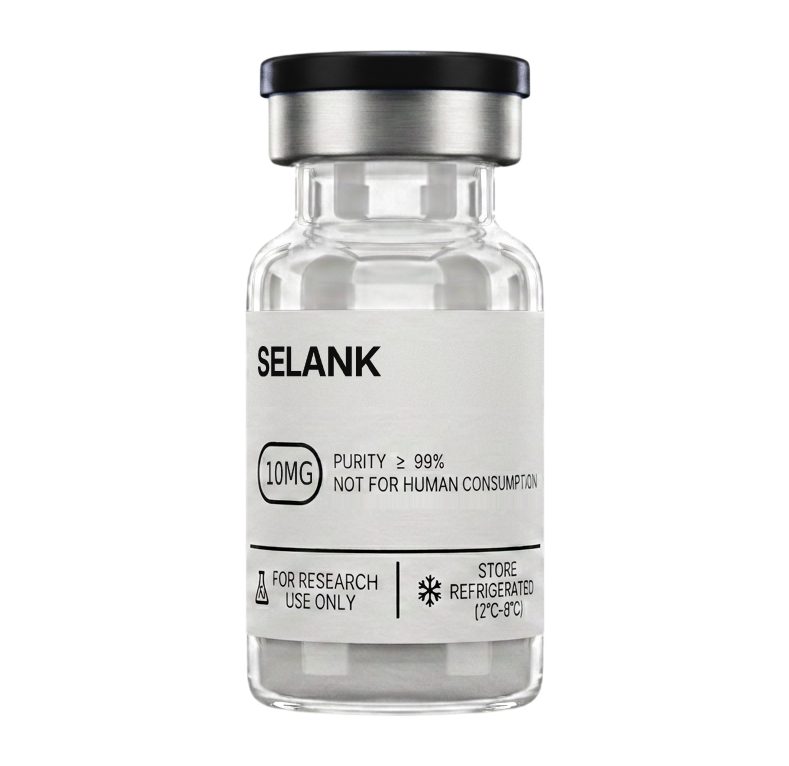
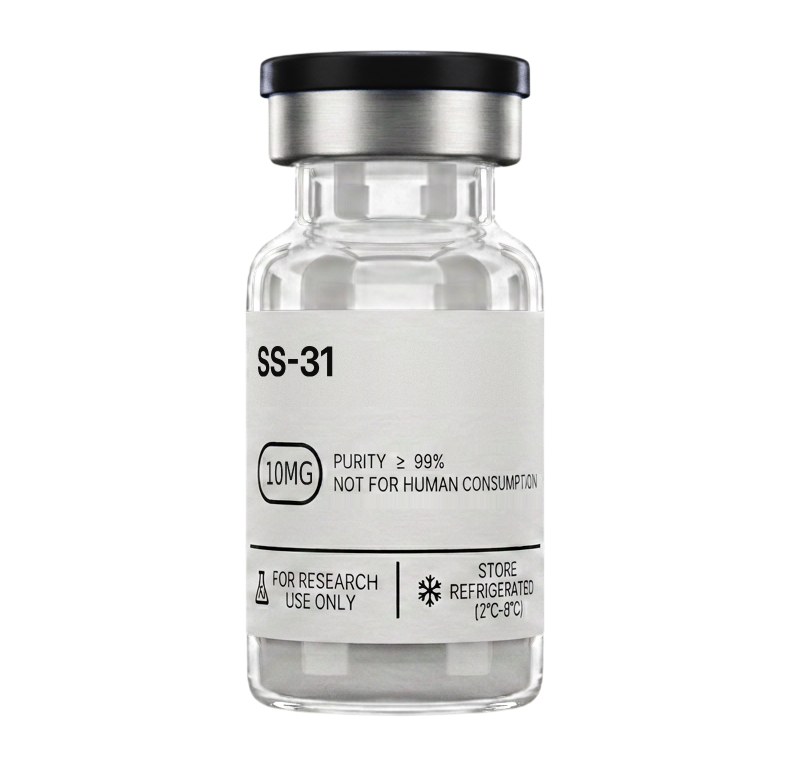



Product labels describe peptides in milligrams, but in-vitro experiments are usually designed in molar units: micromolar or nanomolar concentrations in a well, a cuvette or a binding assay. Converting between the two is simple arithmetic, but two details catch many people out: the difference between powder weight and peptide weight, and which molecular weight to use.
This guide works through the conversions step by step. For mg/mL planning, our peptide calculator handles the first step.
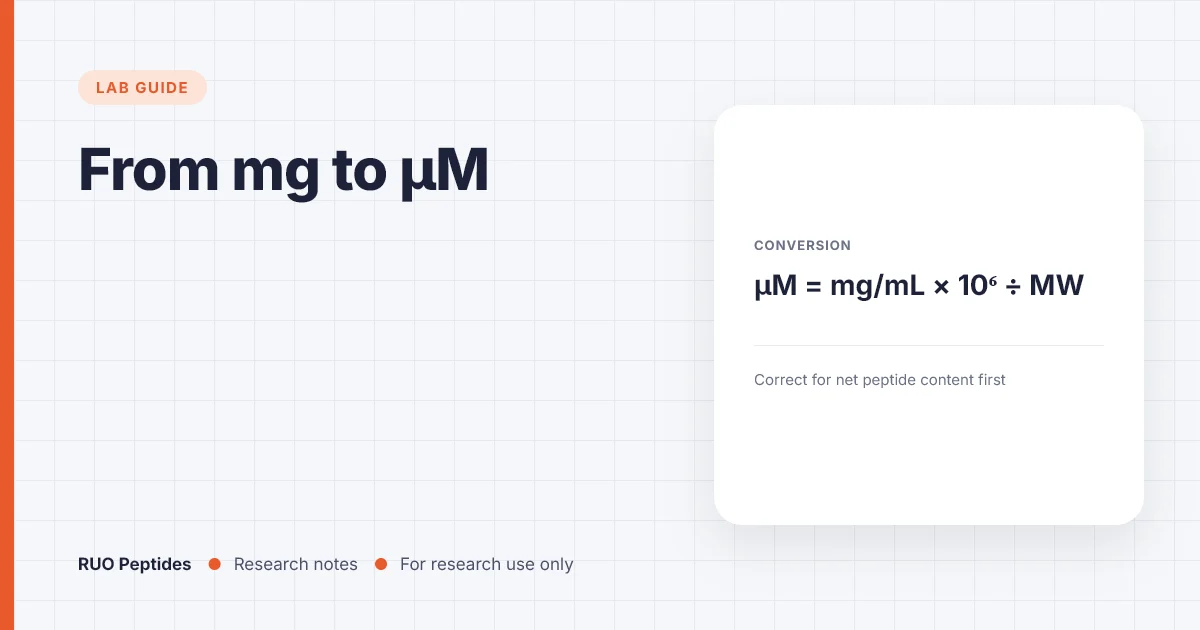
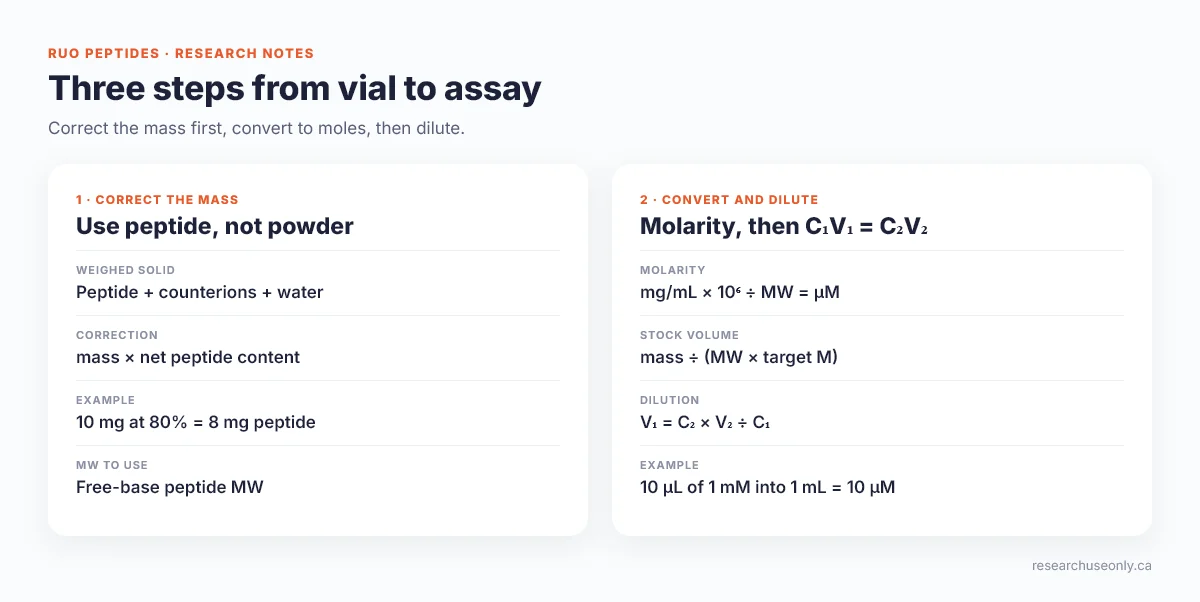
- In-vitro work is planned in molar units. Convert with µM = mg/mL × 1,000,000 ÷ MW.
- Correct for net peptide content first. The powder includes counterions and water, so 10 mg of solid is not 10 mg of peptide.
- Use the free-base molecular weight of the peptide together with the peptide-content figure.
- Plan dilutions with C₁V₁ = C₂V₂ and make stocks concentrated enough that the working dilution is accurate.
Why molar units matter
Biological effects depend on the number of molecules, not their mass. A milligram of a 640 g/mol peptide contains more than three times as many molecules as a milligram of a 2,175 g/mol peptide. Molar units make results comparable across peptides and with the published literature, which almost always reports concentrations such as IC₅₀ or EC₅₀ in molar terms.
The core conversion
Molarity is mass concentration divided by molecular weight. With concentrations in mg/mL and molecular weight in g/mol, the result in micromolar is:
Worked values for a 1 mg/mL solution of peptide (not powder):
| Peptide | MW (g/mol) | 1 mg/mL equals |
|---|---|---|
| SS-31 | 639.8 | 1,563 µM (1.56 mM) |
| Selank | 751.9 | 1,330 µM (1.33 mM) |
| Semax | 813.9 | 1,229 µM (1.23 mM) |
| MOTS-c | 2,174.6 | 459.9 µM (0.46 mM) |
Correcting for net peptide content
The solid in a vial contains the peptide plus counterions (often TFA or acetate) and some residual water. Net peptide content is the fraction that is actually peptide, often in the range of 70–90%. If you skip this correction, every concentration you calculate will be too high.
Example: a lot of MOTS-c with 80% net peptide content. A 1 mg/mL solution made from the powder contains 0.8 mg/mL of peptide, which is 0.8 × 1,000,000 ÷ 2,174.6 = 368 µM, not 460 µM.
Use the free-base molecular weight of the peptide together with the peptide-content figure. Using a salt-form MW and the peptide content together corrects twice. For more on what reduces peptide content, see Peptide Content vs. Purity and TFA vs. Acetate vs. HCl.
Preparing a stock solution
To make a stock at a target molarity, rearrange the formula to solve for volume:
Example: 10 mg of MOTS-c powder at 80% net peptide content (8 mg peptide), targeting a 1 mM stock:
- 0.008 g ÷ (2,174.6 g/mol × 0.001 mol/L) = 0.00368 L
- Dissolve in 3.68 mL of solvent for a 1 mM stock
- Without the content correction you would use 4.60 mL and get about 0.8 mM, a 20% error
Choose the solvent from the peptide’s properties and your assay. Water or buffer suits most hydrophilic peptides; dilute acetic acid can help dissolve basic peptides; DMSO is used for hydrophobic peptides, keeping its final concentration in cell assays low and matched in controls.
Planning dilutions with C₁V₁ = C₂V₂
To go from a stock to a working concentration, use C₁V₁ = C₂V₂, where C₁ and V₁ are the stock concentration and volume taken, and C₂ and V₂ are the final concentration and volume.
Example: to make 1 mL of 10 µM working solution from a 1 mM stock, V₁ = (10 µM × 1 mL) ÷ 1,000 µM = 10 µL of stock plus 990 µL of buffer.
For dose-response work, serial dilutions keep pipetting volumes accurate:
| Tube | Preparation | Concentration |
|---|---|---|
| 1 mM stock | — | 1,000 µM |
| Step 1 | 10 µL stock + 90 µL buffer | 100 µM |
| Step 2 | 10 µL step 1 + 90 µL buffer | 10 µM |
| Step 3 | 10 µL step 2 + 90 µL buffer | 1 µM |
| Step 4 | 10 µL step 3 + 90 µL buffer | 100 nM |
Practical notes
- Low concentrations and plastics: peptides at nanomolar levels can adsorb to tube and plate walls. Low-binding plastics or a carrier protein in the buffer reduce losses.
- Aliquot stocks to avoid repeated freeze-thaw cycles. See Lyophilized Peptide Storage and Handling.
- Record the lot, its net peptide content and the MW you used, so results can be compared across lots.
- Check the CoA MW against the expected value for the sequence and any modifications.
Frequently asked questions
Which molecular weight should I use?
Use the free-base molecular weight of the peptide sequence, including any modifications, and correct the weighed mass with the net peptide content. Do not use a salt-form MW as well, or you will correct twice.
Why is there less peptide in the vial than the label says?
The vial label usually gives the mass of solid, which includes counterions and residual water. Net peptide content, often 70–90%, tells you how much of that solid is peptide.
How do I convert µM to mg/mL?
Reverse the formula: mg/mL = µM × MW ÷ 1,000,000. For example, 100 µM of a 2,174.6 g/mol peptide is about 0.217 mg/mL.
Sources
- MOTS-c chemical data, Wikipedia
- Elamipretide (SS-31) compound data, Selleck Chemicals
- Erckes V et al., counterion content of synthetic peptides, Pharmaceuticals (2025)
Related research
Browse the catalogue: see the current research peptides available in Canada, each listed with amount, purity and storage details. For research use only.