



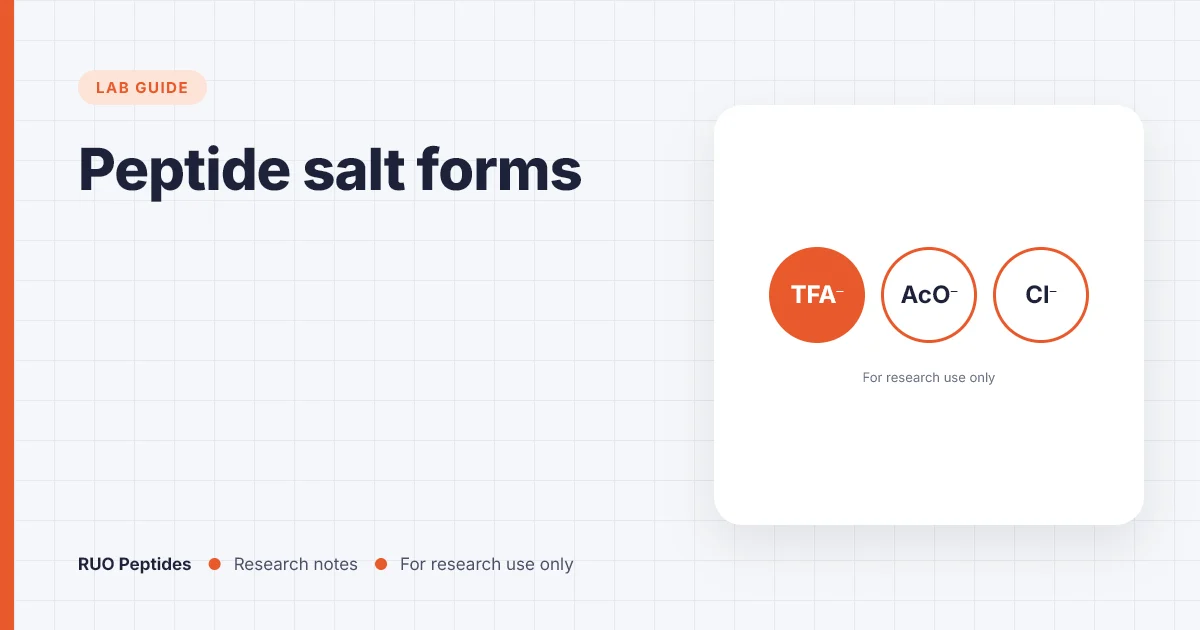
A lyophilized peptide is almost never the pure peptide molecule. Positively charged groups on the peptide carry negatively charged counterions, and those counterions are weighed, dissolved and added to your assay along with the peptide. For most synthetic peptides the counterion is trifluoroacetate (TFA).
This guide explains where TFA comes from, how much of the vial weight it can account for, why it matters for some experiments, and what acetate and hydrochloride (HCl) salts offer instead.
- Most synthetic peptides are supplied as TFA salts because TFA is used to cleave peptides from the resin and in HPLC purification.
- The counterion adds weight. In a 2025 study, TFA made up about a third of the solid’s weight for the peptides tested.
- Residual TFA has been reported to change cell proliferation in some assays, so acetate or HCl salts are often preferred for cell work.
- Ask for the salt form and peptide content on the CoA. TFA can be measured by ¹⁹F NMR, HPLC-ELSD or ion chromatography.
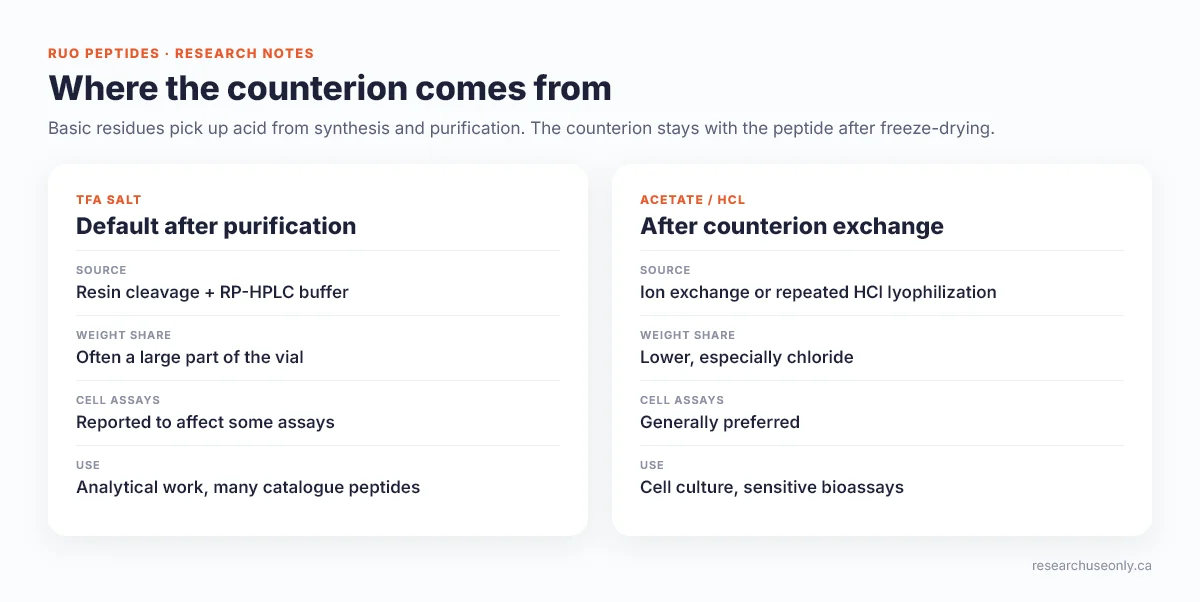
Why peptides are salts
Peptides contain basic groups: the N-terminal amine and the side chains of lysine, arginine and histidine. In acidic conditions these groups are protonated and positively charged, and each one pairs with an anion. When the peptide is freeze-dried, those anions stay in the solid. The more basic residues a peptide has, the more counterions it carries.
This is why a CoA may list a peptide as, for example, “acetate salt” or “TFA salt”, and why the weight of solid in a vial is higher than the weight of peptide. For the full picture of what else is in the vial, see Peptide Content vs. Purity.
Where TFA comes from
TFA enters at two steps of standard Fmoc solid-phase peptide synthesis:
- Cleavage and deprotection: concentrated TFA releases the finished peptide from the resin and removes side-chain protecting groups.
- Purification: reversed-phase HPLC typically uses dilute TFA in the mobile phase as an ion-pairing agent, because it gives sharp peaks.
After purification and lyophilization, the peptide is left as a TFA salt unless an extra exchange step is added.
How much of the vial is counterion
A 2025 study in Pharmaceuticals measured TFA in purified test peptides and found it accounted for about 0.33 mg per mg of solid, roughly a third of the weight. That was above the roughly 25% expected from the number of basic groups alone, because excess TFA can remain. For the same peptides, the chloride form was expected to account for about 10%.
The practical effect is on concentration. If a third of the weighed solid is TFA, a solution made up by weight contains noticeably less peptide than the label mass suggests. Our guide to molarity calculations shows how to correct for this.
TFA in cell and biochemical assays
For analytical work, a TFA salt is usually fine. Cell-based work is more sensitive:
- A 1999 study by Cornish and colleagues found that trifluoroacetate inhibited the proliferation of osteoblasts and chondrocytes, at concentrations that could be reached when TFA-salt peptides were added to culture.
- Other reports describe TFA increasing cell growth at higher concentrations. The direction of the effect depends on the system.
- The 2025 review also notes reports of TFA affecting toxicity readouts and antibody responses.
Comparing TFA, acetate and HCl
| TFA | Acetate | HCl | |
|---|---|---|---|
| How it arises | Default after cleavage and RP-HPLC | Exchange, or purification with acetic acid buffers | Exchange by repeated HCl treatment and lyophilization |
| Relative counterion weight | Highest | Lower | Lowest |
| Cell-assay suitability | May interfere | Generally preferred | Generally preferred |
| Trade-offs | Cheapest, no extra step | Extra step; acetate is volatile and can be partly lost | Extra step; strong acid exposure during exchange |
There is no single best salt form. The choice depends on the experiment: analytical reference work tolerates TFA, while cell culture and sensitive bioassays usually call for acetate or HCl.
How counterions are exchanged and measured
The 2025 study reviewed the main exchange methods: repeated dissolution in dilute HCl followed by lyophilization (the most widely used), anion-exchange resins, and HPLC with a different acid in the mobile phase. In its tests, a single cycle with 10 mM HCl brought TFA below the limit of quantification while keeping purity above 96%.
To confirm the result, TFA can be measured by:
- ¹⁹F NMR, which detects the fluorine atoms in TFA directly.
- HPLC with evaporative light-scattering detection (ELSD), which can also quantify chloride.
- Ion chromatography, an established method for anions.
- FT-IR, useful as a qualitative check but much less sensitive.
What to ask your supplier
- Which salt form is the lot supplied as?
- What is the net peptide content, and how was it measured?
- If an exchanged salt is supplied, what residual TFA was measured, and by which method?
- Does the CoA lot number match the vial?
For a full checklist, see How to Choose a Research Peptide Supplier in Canada.
Frequently asked questions
Why is my peptide a TFA salt?
TFA is used to cleave peptides from the synthesis resin and as an additive in HPLC purification. It binds to the peptide’s basic groups and remains after freeze-drying unless an exchange step is added.
Does the salt form change the peptide itself?
No. The peptide sequence is the same. The salt form changes what else is in the solid, which affects how much peptide you get per milligram weighed and can affect some cell assays.
Is acetate or HCl better for cell culture?
Both are generally preferred over TFA for cell work. HCl adds the least weight; acetate is milder but can be partly lost because acetic acid is volatile. The right choice depends on the experiment.
Sources
- Erckes V et al., “Towards a Consensus for the Analysis and Exchange of TFA as a Counterion in Synthetic Peptides”, Pharmaceuticals (2025)
- Cornish J et al., “Trifluoroacetate, a contaminant in purified proteins, inhibits proliferation of osteoblasts and chondrocytes”, American Journal of Physiology (1999)
- GenScript, Impact of counter-ion in peptide studies
Related research
Browse the catalogue: see the current research peptides available in Canada, each listed with amount, purity and storage details. For research use only.