
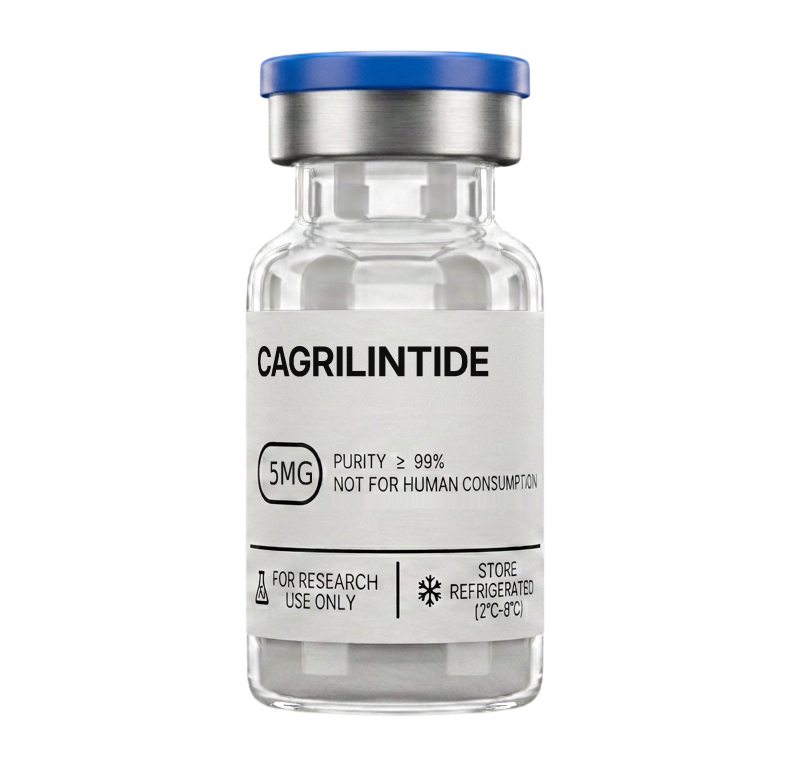


Most attention in metabolic peptide research goes to GLP-1 receptor agonists and their multi-receptor successors. A second hormone family, the amylin analogues, has moved quickly in the same period. Cagrilintide is the most advanced of them, and it is usually studied alongside a GLP-1 agonist rather than in place of one.
This guide explains how amylin differs from GLP-1, why native amylin is hard to work with, how cagrilintide was engineered, and where the amylin class stands in 2026.
- Amylin is a 37-residue hormone co-secreted with insulin. It signals through calcitonin receptor–RAMP complexes, not the GLP-1 receptor.
- Native amylin aggregates and is short-lived. Pramlintide (US approval 2005) and cagrilintide were engineered to get around this.
- Cagrilintide is a lipidated, long-acting amylin analogue from Novo Nordisk. With semaglutide it forms CagriSema, which was submitted to the US FDA in December 2025.
- Cagrilintide is not a GLP-1 agonist and is not approved in Canada.
Two hormone families
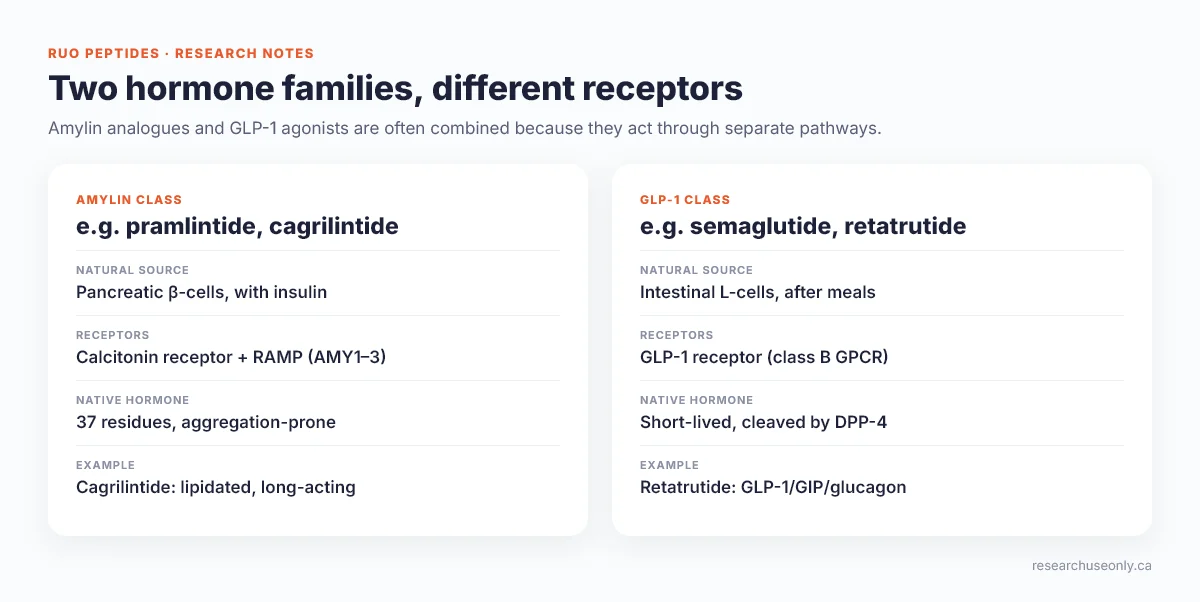
GLP-1 (glucagon-like peptide-1) is an incretin released by intestinal L-cells after a meal. It acts on the GLP-1 receptor and is broken down within minutes by the enzyme DPP-4. Semaglutide, tirzepatide and retatrutide are all built around this receptor, with tirzepatide and retatrutide adding GIP and glucagon receptor activity. See Retatrutide vs. Tirzepatide.
Amylin (islet amyloid polypeptide) is a 37-residue hormone released from pancreatic β-cells together with insulin. It acts on a different receptor system: the calcitonin receptor paired with one of three receptor activity-modifying proteins (RAMPs), forming the amylin receptors AMY1, AMY2 and AMY3.
| Amylin class | GLP-1 class | |
|---|---|---|
| Released by | Pancreatic β-cells, with insulin | Intestinal L-cells, after meals |
| Receptor | Calcitonin receptor + RAMP1/2/3 | GLP-1 receptor |
| Main challenge for analogues | Aggregation and short half-life | Rapid DPP-4 cleavage and clearance |
| Approved analogues | Pramlintide (US, 2005) | Several, including semaglutide |
| Research examples | Cagrilintide, petrelintide, eloralintide | Semaglutide, retatrutide |
Why native amylin is hard to use
Human amylin readily forms amyloid fibrils, the same aggregates found in the pancreas in type 2 diabetes. It is also cleared quickly. Both properties make the native hormone a poor research tool and a poor drug.
Pramlintide (Symlin), approved in the US in 2005 as an add-on to mealtime insulin, solved the aggregation problem by substituting prolines at key positions. It is still short-acting and has to be given with each meal, which limited its use.
How cagrilintide was designed
Novo Nordisk scientists described cagrilintide in the Journal of Medicinal Chemistry in 2021 as a stable, lipidated, long-acting amylin analogue. The design follows the same strategy used for semaglutide:
- Lipidation: a C20 fatty diacid is attached through a γ-glutamate spacer to a lysine side chain. The fatty acid binds serum albumin, which slows clearance and supports once-weekly administration in clinical studies.
- Stabilizing substitutions reduce the aggregation that limits native amylin.
- Disulfide bridge and C-terminal amide, both shared with native amylin and needed for receptor activity.
Cagrilintide acts on both amylin receptors and the calcitonin receptor.

CagriSema: trial results and status
CagriSema combines cagrilintide with semaglutide. In June 2025 Novo Nordisk reported the Phase 3 REDEFINE results, published in the New England Journal of Medicine:
- REDEFINE 1 (3,417 adults without type 2 diabetes, 68 weeks): mean weight loss of 20.4% with CagriSema vs. 3.0% with placebo.
- REDEFINE 2 (1,206 adults with type 2 diabetes, 68 weeks): 13.7% vs. 3.4%.
Novo Nordisk submitted a New Drug Application to the US FDA in December 2025. At the time of writing, a decision was expected in late 2026. CagriSema is not approved in the US, the EU or Canada.
Other amylin-class compounds in 2026
| Compound | Type | Developer | Stage |
|---|---|---|---|
| Pramlintide | Amylin analogue | Amylin Pharmaceuticals | Approved in the US (2005) |
| Cagrilintide | Long-acting amylin analogue | Novo Nordisk | In CagriSema; US NDA submitted Dec 2025 |
| Amycretin | Single molecule, GLP-1 + amylin agonist | Novo Nordisk | Phase 3 planned from 2026 |
| Petrelintide | Long-acting amylin analogue | Zealand Pharma / Roche | Phase 2 ZUPREME-1 reported 2026 |
| Eloralintide | Amylin receptor agonist | Eli Lilly | Moving to Phase 3 after 2025 Phase 2 |
The common thread is the move away from short-acting amylin toward once-weekly molecules, and toward combinations or dual agonists that pair amylin activity with GLP-1 activity.
What a cagrilintide CoA should confirm
- Mass identity that includes the lipid chain. A mass far below the expected value can mean the fatty acid or spacer is missing.
- Intact disulfide. The oxidized (disulfide) form is about 2 Da lighter than the reduced form.
- HPLC purity with the chromatogram. Lipidated peptides elute late on reversed-phase columns; ask how closely related impurities were resolved.
- Peptide content and salt form, since large peptides carry many counterions. See Peptide Content vs. Purity.
In Canada, peptides with therapeutic use are regulated as prescription drugs. Health Canada’s April 2026 advisory states that research-use-only labels do not make unauthorized products legal for personal use.
Frequently asked questions
Is cagrilintide a GLP-1 agonist?
No. Cagrilintide is an amylin analogue that acts on amylin and calcitonin receptors. It is combined with the GLP-1 agonist semaglutide in CagriSema, but the two molecules act on different receptors.
Is CagriSema approved in Canada?
No. Novo Nordisk submitted CagriSema to the US FDA in December 2025. It is not approved in Canada, the US or the EU as of this writing.
Why is native amylin difficult to work with?
Human amylin aggregates into amyloid fibrils and is cleared quickly. Analogues such as pramlintide and cagrilintide use amino-acid substitutions, and in cagrilintide’s case lipidation, to improve stability and duration.
Sources
- Kruse T et al., “Development of Cagrilintide, a Long-Acting Amylin Analogue”, Journal of Medicinal Chemistry (2021), RCSB PDB 7BG0
- Cagrilintide chemical data, Wikipedia
- Novo Nordisk Canada, REDEFINE 1 and 2 results (June 2025)
- Novo Nordisk, CagriSema submitted to the US FDA (December 2025)
- FDA approval of pramlintide (Symlin), Lab Online (March 2005)
- Amycretin development update, Pharma Focus Europe (June 2025)
- Petrelintide Phase 2 topline results, Drug Topics (March 2026)
- Eloralintide Phase 2 results, Clinical Trials Arena (November 2025)