
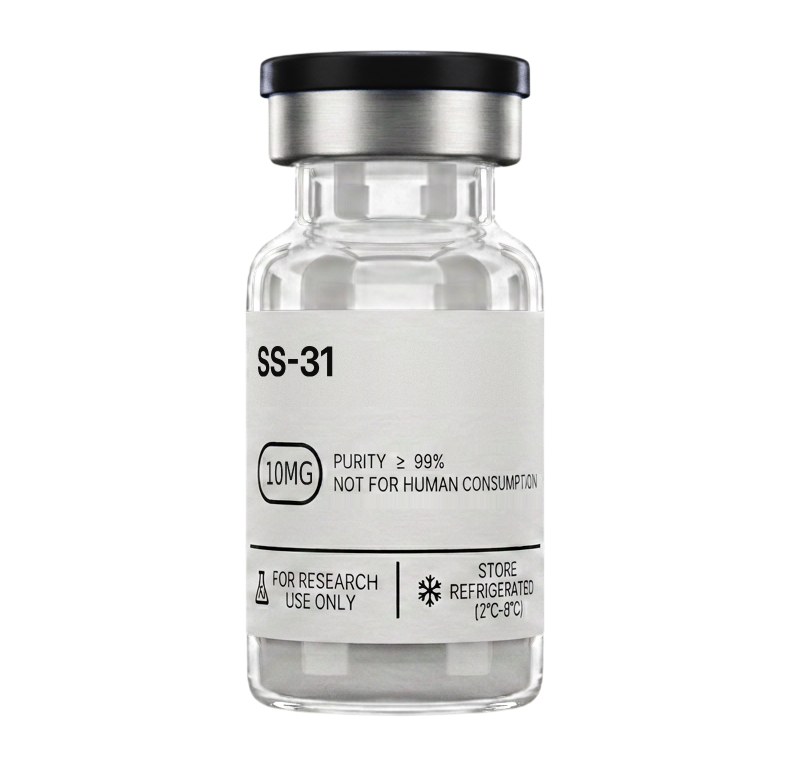


MOTS-c and SS-31 often appear on the same lists of “mitochondrial peptides”, and both are studied in models of metabolism and ageing. Beyond that label they have very little in common. One is a natural peptide encoded by the mitochondria’s own DNA that behaves like a signalling hormone. The other is a short synthetic peptide designed to lodge in the inner mitochondrial membrane.
This guide compares where each comes from, how each is thought to act, how far each has progressed clinically, and what a Certificate of Analysis should confirm for each.
- MOTS-c is a natural 16-residue peptide encoded in the mitochondrial 12S rRNA gene. SS-31 is a synthetic four-residue peptide.
- MOTS-c is studied as a signalling molecule (folate cycle, AMPK, nuclear gene regulation). SS-31 is studied as a membrane-targeting agent that binds cardiolipin.
- As elamipretide, SS-31 received US FDA accelerated approval for Barth syndrome in September 2025. No MOTS-c-based product has been approved.
- Their CoAs need different checks: oxidation for methionine-containing MOTS-c, non-standard residues and chirality for SS-31.
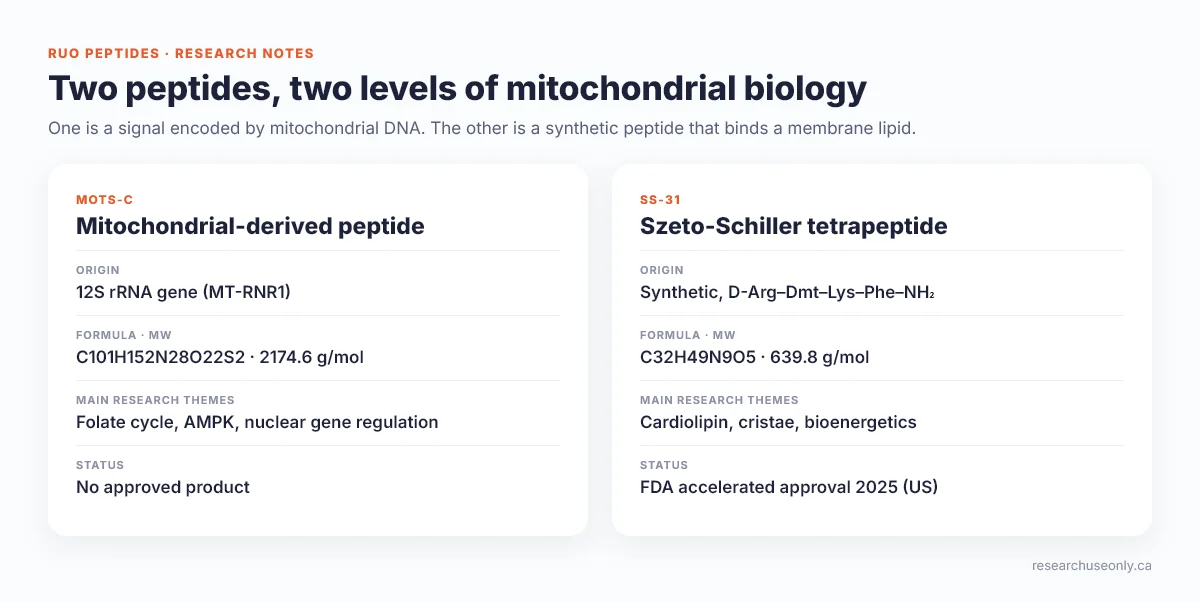
MOTS-c and SS-31 at a glance
| MOTS-c | SS-31 | |
|---|---|---|
| Origin | Encoded in mitochondrial DNA (MT-RNR1, the 12S rRNA gene) | Synthetic; Szeto-Schiller peptide family |
| Length | 16 residues | 4 residues |
| Sequence | MRWQEMGYIFYPRKLR | D-Arg–Dmt–Lys–Phe–NH₂ |
| Molecular weight | About 2,174.6 g/mol | 639.8 g/mol (free base) |
| CAS number | 1627580-64-6 | 736992-21-5 |
| Primary target | Metabolic signalling (folate cycle, AMPK); nuclear gene regulation under stress | Cardiolipin in the inner mitochondrial membrane |
| Clinical status | No approved product; the analogue CB4211 was not developed beyond Phase 1 | Elamipretide (Forzinity), FDA accelerated approval for Barth syndrome, Sept 2025 |
Where each peptide comes from
MOTS-c (mitochondrial open reading frame of the 12S rRNA type-c) was described in 2015 by Changhan Lee, Pinchas Cohen and colleagues in Cell Metabolism. It belongs to a small group of mitochondrial-derived peptides: short peptides encoded within the mitochondrial genome rather than in the cell nucleus. Humanin is the best-known other member of the group.
SS-31 comes from the opposite direction. It was designed by Hazel Szeto and Peter Schiller as part of a family of aromatic-cationic peptides that cross cell membranes and concentrate in mitochondria. Its D-arginine and the non-standard residue 2′,6′-dimethyltyrosine (Dmt) do not occur in natural proteins. For more detail, see our SS-31 compound guide.
How they act on mitochondria
The simplest way to separate the two is by level. MOTS-c is studied as a messenger that changes how cells use fuel. SS-31 is studied as a structural agent that changes how the inner membrane behaves.
MOTS-c: a metabolic signal
- In the 2015 discovery paper, MOTS-c acted mainly on skeletal muscle. It inhibited the folate cycle and de novo purine synthesis, which led to activation of AMPK, a central energy sensor.
- In mice, MOTS-c treatment prevented diet-induced obesity and both age-related and diet-induced insulin resistance.
- A 2018 follow-up from the same group showed that under metabolic stress, such as glucose restriction, MOTS-c moves into the nucleus in an AMPK-dependent way. There it regulates stress-response genes, including genes with antioxidant response elements, and interacts with NRF2.
SS-31: a membrane-targeting peptide
- SS-31 concentrates on the inner mitochondrial membrane and binds cardiolipin, a phospholipid that shapes the cristae and holds respiratory complexes together.
- Its binding limits the peroxidase activity of cytochrome c, which otherwise oxidizes cardiolipin under stress.
- In cell and animal models these effects have been linked to better ATP production and lower formation of reactive oxygen species.
Clinical status
The two peptides have had very different clinical paths.
- SS-31 / elamipretide: on 19 September 2025 the US FDA granted accelerated approval to Forzinity (elamipretide) as the first treatment for Barth syndrome, for patients weighing at least 30 kg. A confirmatory trial is required. In 2026 the developer, Stealth BioTherapeutics, renamed itself Mighty Therapeutics.
- MOTS-c: the main clinical effort was CohBar’s MOTS-c analogue CB4211. A Phase 1a/1b study reported in 2021 showed changes in liver enzymes and glucose, but CohBar later stated that the formulation was not suitable for further development. After CohBar’s 2023 merger, the combined company did not expect to continue the programme. We found no active human development of a MOTS-c analogue.
What each CoA should confirm
Both peptides need a lot-specific Certificate of Analysis with mass spectrometry identity and an HPLC chromatogram. The details to look for differ.
MOTS-c
- Mass identity consistent with an average molecular weight of about 2,174.6. Peptides of this size often appear as multiply charged ions, such as [M+2H]²⁺ or [M+3H]³⁺.
- Oxidation: MOTS-c contains two methionines and a tryptophan. Peaks at about +16 Da can indicate oxidized forms. See How Peptides Degrade.
- Peptide content and salt form, since the vial weight includes counterions and residual water.
SS-31
- Mass identity near a monoisotopic mass of about 639.4 Da, usually seen as [M+H]⁺ near 640.4. A mass about 14 Da lower can indicate tyrosine in place of Dmt.
- Chirality: standard HPLC and MS cannot distinguish D-Arg from L-Arg. Where stereochemistry matters, ask about chiral analysis or synthesis records.
- Salt form, commonly acetate or TFA. See TFA vs. Acetate vs. HCl.

Canadian regulatory context
Neither MOTS-c nor elamipretide is approved as a drug in Canada. Forzinity’s approval is a US FDA decision and does not authorize sale in Canada. Health Canada’s April 2026 advisory on unauthorized injectable peptides states that labels such as “For Research Use Only – Not for Human Consumption” do not make a product legal for personal use.
Frequently asked questions
Are MOTS-c and SS-31 related?
No. Both are studied in mitochondrial biology, but they share no sequence or origin. MOTS-c is a natural peptide encoded by mitochondrial DNA; SS-31 is a synthetic tetrapeptide.
Is either peptide approved in Canada?
No. Elamipretide (SS-31) has US FDA accelerated approval for Barth syndrome, but that does not extend to Canada. No MOTS-c product has been approved anywhere.
Why does a MOTS-c CoA need an oxidation check?
MOTS-c contains two methionines and a tryptophan, which can oxidize during synthesis, storage or handling. Oxidized forms show up as extra peaks about 16 Da heavier in mass spectrometry.
Sources
- Lee C et al., “The mitochondrial-derived peptide MOTS-c promotes metabolic homeostasis and reduces obesity and insulin resistance”, Cell Metabolism (2015)
- Kim KH et al., “The mitochondrial-encoded peptide MOTS-c translocates to the nucleus to regulate nuclear gene expression”, Cell Metabolism (2018)
- MOTS-c sequence and chemical data, Wikipedia
- FDA, accelerated approval of the first treatment for Barth syndrome (September 2025)
- CohBar, Phase 1a/1b topline results for CB4211 (2021)
- Health Canada, advisory on unauthorized injectable peptides (April 2026)