


Product listings and Certificates of Analysis for research peptides use a lot of technical shorthand. This glossary defines the common terms in plain language, grouped by the question each one helps answer, with links to our longer guides.
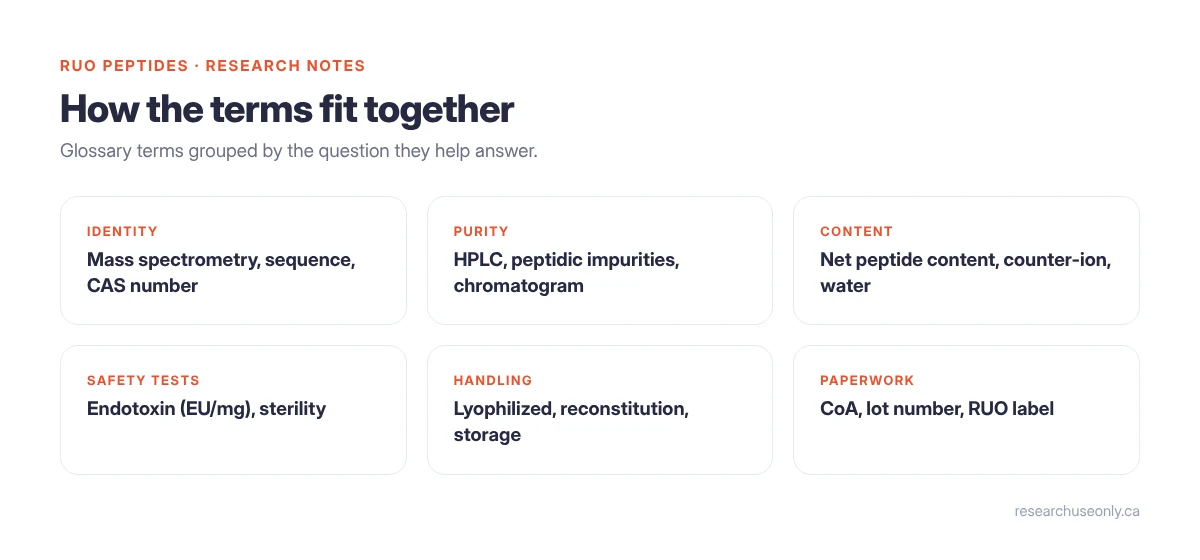
- Identity terms tell you whether the vial contains the right molecule.
- Purity and content terms tell you how clean the material is and how much of the powder is peptide.
- Safety test terms cover bacterial contaminants such as endotoxin.
- Handling and paperwork terms cover storage, reconstitution, lot tracking and labelling.
Identity
| Term | Meaning |
| Mass spectrometry (MS) | Measures the mass of molecules in a sample. A match between observed and expected mass confirms identity. See HPLC vs. mass spec. |
| Monoisotopic mass | The mass of a molecule calculated with the most common isotope of each element. Used to compare against MS results. |
| [M+H]⁺, [M+2H]²⁺ | Ions seen in MS when a peptide picks up one or two protons. The second appears at roughly half the mass. |
| Sequence | The order of amino acids in a peptide, written in three-letter or one-letter codes. |
| CAS number | A unique registry number for a chemical substance, useful for confirming which compound a document refers to. |
| Analogue | A molecule modified from a natural peptide, for example to resist breakdown. |
Purity and content
| Term | Meaning |
| HPLC | High-performance liquid chromatography. Separates a sample into components and reports purity as the share of signal in the main peak. |
| Chromatogram | The trace produced by HPLC. Peaks show the main compound and impurities. |
| Peptidic impurities | Related sequences left from synthesis, such as deletion or truncated peptides. |
| Net peptide content (NPC) | The share of the powder weight that is peptide, as opposed to counter-ions and water. See Peptide Content vs. Purity. |
| Counter-ion / salt form | Ions paired with the peptide, usually trifluoroacetate (TFA) or acetate. They add weight. |
| TFA | Trifluoroacetic acid, used in peptide synthesis and purification. Residual TFA is the most common counter-ion. |
Safety tests
| Term | Meaning |
| Endotoxin | Lipopolysaccharide from gram-negative bacteria. Heat-stable and active in immune cells at very low levels. |
| EU (endotoxin unit) | Standard unit for endotoxin activity, usually reported per mg or per vial. |
| LAL / rFC | Limulus amebocyte lysate and recombinant factor C, the two main endotoxin test methods. |
| Sterility test | A culture test, typically 14 days, that checks for living bacteria or fungi. See Endotoxin and Sterility Testing. |
Handling and stability
| Term | Meaning |
| Lyophilized | Freeze-dried. Removing water makes the peptide much more stable for storage and shipping. |
| Reconstitution | Dissolving a lyophilized peptide in a measured volume of liquid for laboratory use. |
| Bacteriostatic water | Sterile water with 0.9% benzyl alcohol, which inhibits bacterial growth in multi-use vials. |
| Oxidation | A chemical change, most often at methionine, that adds about 16 Da. |
| Deamidation | Loss of an amide group from asparagine or glutamine, adding about 1 Da. See How Peptides Degrade. |
| Aggregation | Peptide molecules sticking together, which can reduce the usable amount. |
Paperwork and labelling
| Term | Meaning |
| Certificate of Analysis (CoA) | The test report for a lot, listing identity, purity and other results. See How to Read a CoA. |
| Lot (batch) number | The identifier that links a vial to its production run and CoA. |
| RUO | Research Use Only. A statement that a product is intended for laboratory research. It is not a regulatory approval. See What RUO Means in Canada. |
| DIN | Drug Identification Number. The eight-digit number on drugs authorized for sale in Canada. |
Frequently asked questions
What is the difference between purity and peptide content?
Purity is the share of the peptidic material that is the target sequence. Peptide content is the share of the whole powder that is peptide, after counter-ions and water.
What does lyophilized mean?
Freeze-dried. The peptide is supplied as a dry powder, which is far more stable than a solution.
What is a lot number for?
It links your vial to a specific production run and its Certificate of Analysis, so the test data applies to the material you have.
Does RUO mean a product is approved?
No. Research Use Only describes intended use. It is not an approval from Health Canada.
Sources
- Net peptide content and HPLC purity definitions, Bachem
- Bacterial endotoxins testing, Eurofins
- Deamidation, Wikipedia
- Health Canada, advisory on unauthorized injectable peptides (April 2026)
Related reading
Browse the catalogue: see the current research peptides available in Canada, each listed with amount, purity and storage details. For research use only.